
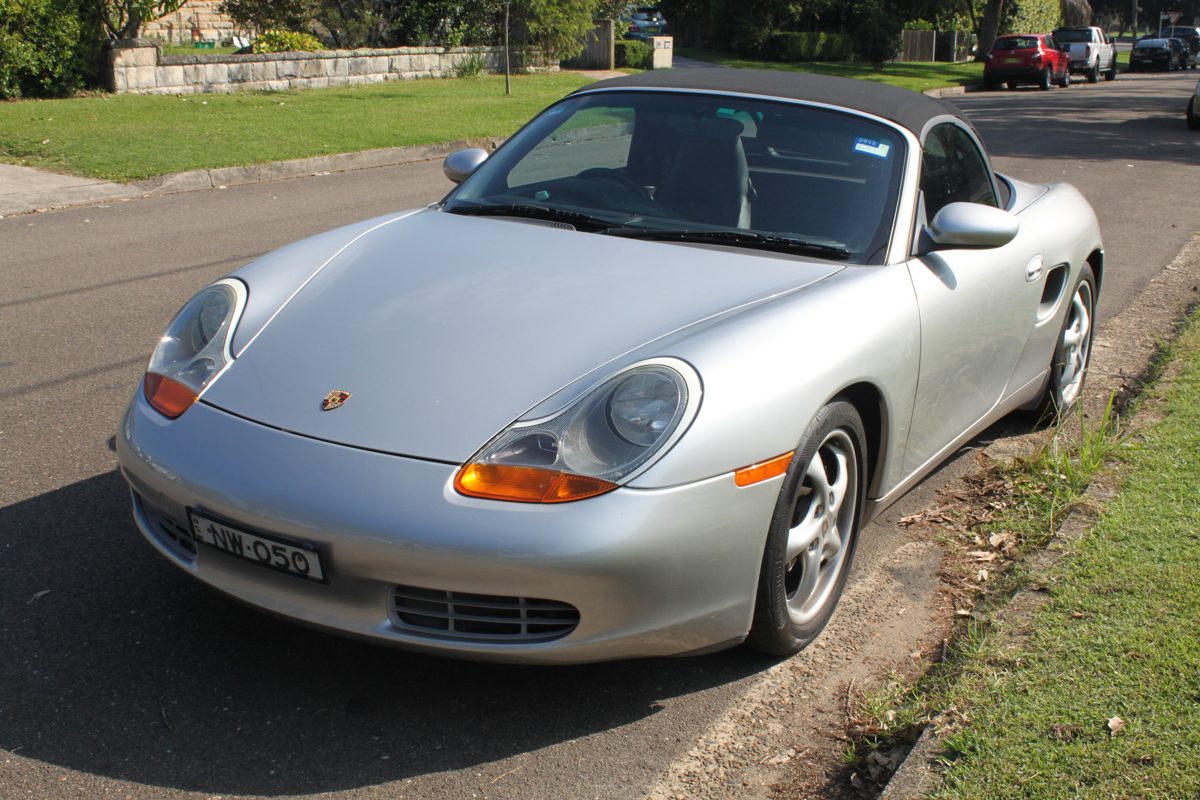
The original Boxster, internally the 986, ranks fifth because it connects an approachable sports-car idea with an important reorganization of Porsche's product strategy. The concept appeared at Detroit in 1993, and the production roadster launched in Europe in August 1996; the United States followed in 1997. Those dates explain why photographs, model years and anniversary accounts may appear to disagree when they actually refer to different milestones. For this guide, the subject is the first production generation. The 2021 anniversary edition and later 718 derivatives are separate vehicles, even when a retrospective illustrates several decades on one page.
Its mid-engine arrangement links it with the 914 while its rounded body speaks a different design language. The engine sits ahead of the rear axle, and the open two-seat cabin is part of a roadster designed around that position. Compare the view from the side with the 911 rather than assuming similar front styling implies identical architecture. A family resemblance can coexist with a fundamental mechanical distinction. That is one reason the Boxster is such an effective learning model: it makes the difference between visual identity and component layout easy to discuss without claiming that a photograph reveals how the car drives.
Shared parts and a distinct roadster
Water cooling and shared components are another part of the story. Porsche's historical account connects the Boxster with the development of the 996-generation 911 and an intelligent carry-over-parts strategy. This is more interesting than presenting sharing as either a shameful shortcut or a magical solution with no compromises. A manufacturer has to organize engineering, production and a range of products together. The Boxster shows how decisions about common parts can sit beside a distinctive overall vehicle. Its historical significance therefore includes the way the company worked, not just the appearance of the finished roadster.
The concept-to-production comparison offers a manageable exercise. Find a dated image of the 1993 show car, then compare it with a clearly identified 986. Ask which visual ideas survived and which details belong to the production design. This avoids the common mistake of attaching the specifications of one to the photograph of the other. It also makes the three-year interval meaningful. A concept can communicate an ambition, while the road car has to resolve the many practical decisions needed for production. Similarity is a relationship to investigate, rather than proof that the two objects are mechanically identical.
From concept to production
The photographed example is a 1999 Boxster, recorded in 2016. It represents the first generation without pretending to be the August 1996 launch vehicle. Later Boxster S and subsequent generations introduced their own changes, so this page does not apply a single engine output or transmission description to every car carrying the name. Nor does the search interest in cars for sale tell us anything about the condition of this example. The useful historical question concerns the role of the 986 in the range and the way it connected a new customer proposition with a reworked engineering strategy.
Fifth place rewards that combination of product clarity and wider organizational influence. It can rank higher for a reader who values the continuation of the accessible mid-engine roadster idea more than a rare technological flagship. Compare it with the Carrera GT, which uses a mid-engine layout for a very different brief, and with the Cayenne, which widened the range in another direction. The Boxster's lasting lesson is that a model can be transformative without claiming the largest engine or the highest price. Sometimes the important advance is making a coherent kind of sports car fit a changed company and a changed audience.
Photo: 1999 Boxster 986, photographed 10 April 2016. Jeremy from Sydney, Australia · CC BY 2.0. Resized and JPEG recompressed; no cropping added. Source image license retained.
