
New York State Historic Newspapers ranks fourth for turning a broad geographic label into a practical local research route. The project's current homepage describes free online access to newspapers selected to reflect the state's history and offers searching across the collection or browsing by county. It also provides routes through titles, dates and collections. This is a specialist resource rather than an archive of every newspaper ever published in New York. That focus can be an advantage when a family, business or local event would be difficult to distinguish within a much larger national result set.
Begin with the county route if you know where the subject lived or operated. Then examine which titles and dates are available before interpreting a missing result. A county boundary can help organize a search, but the story itself may cross it. Someone might work in a neighboring town, move between communities or appear in a newspaper printed elsewhere. Use the map or county listing as an entry point rather than a rule about where the evidence must be. Once a notice gives you another locality, write that detail down and consider whether the next search should follow the person rather than remain inside the original boundary.
Follow places, dates and identities
The title and date routes are useful when you know an event more precisely than the words a reporter used. For example, a public meeting might be reported under the name of an organization, a venue or a prominent speaker rather than under the modern topic label you first tried. Browsing nearby issues can reveal that vocabulary. Keep the event date separate from the issue date in your notes. A report printed later may describe what happened earlier, while an advance notice can establish only that something was planned. Neither difference is a trivial detail when you are trying to reconstruct a sequence responsibly.
Small notices deserve as much care as prominent reports. A business address, a family announcement or a meeting advertisement can supply a concrete link between names and places, but the wording may be abbreviated or mistaken. If two people share a surname, do not let a promising search hit decide their identity by itself. Look for a second identifying detail and compare the original image. A plausible match is a lead, not a conclusion. This method keeps a local archive from becoming a source of confident but fragile family stories built on one line whose relationship to the intended person has not been checked.
Turn a local lead into evidence
The project's current pages also describe ways to contribute and correct text. Those features can improve a collection, but participation should follow the site's actual instructions and distinguish a visible printed word from a modern assumption about what ought to have been printed. For a reading project, record transcription uncertainty rather than silently repairing a difficult passage in your quotation. If automatic browser access briefly shows a security check, allow the normal page to load; that transient experience does not establish that ordinary readers need a paid account. We verified the current homepage and its free-access description in a normal browser during research.
Fourth place recognizes strong practical value for a focused American regional question. It can easily outrank the national leader when the relevant county and title are represented here. Google Trends' rising New York historical-newspaper queries support the usefulness of the subject, but they do not prove superior coverage or identify a person in the collection. Choose this archive because its actual holdings fit your question. A good stopping point is a properly identified page plus a clear next step: another issue to inspect, a neighboring county to check or a separate source needed to establish which person a brief notice describes.
Source: New York State Historic Newspapers.
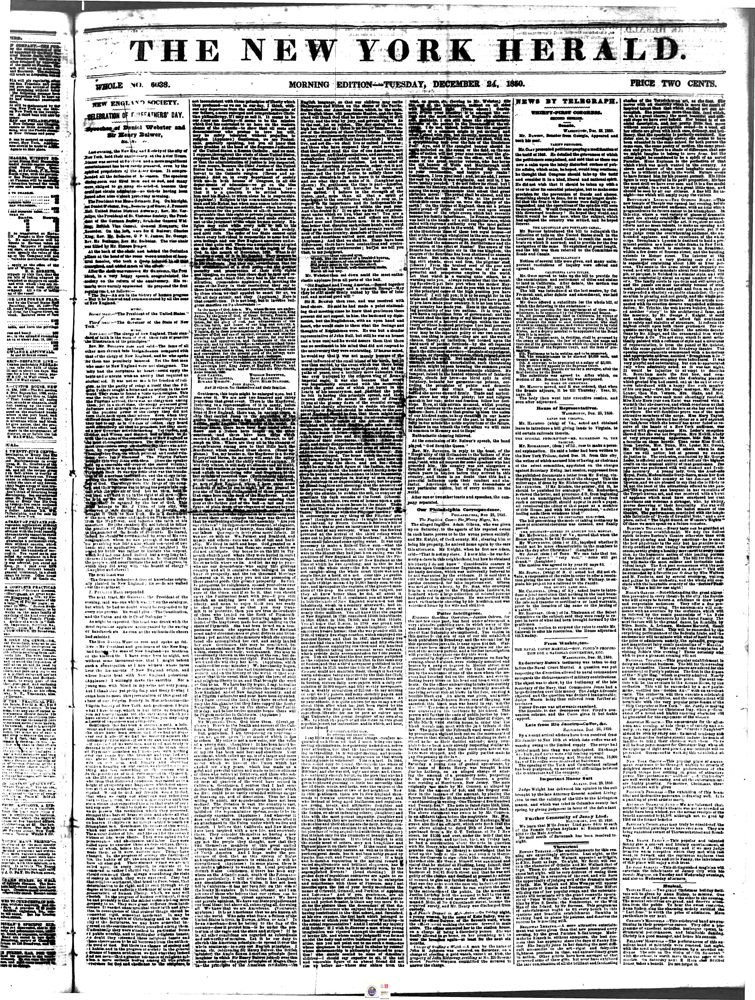
Photo: New York Herald, 1850-12-24, p. 1.jpg · New York Herald · Public domain. Archive illustration, not a current website screenshot or a guarantee of collection holdings. Resized and recompressed without cropping; source image license retained.

