
Dwight Eisenhower’s farewell of 17 January 1961 is usually approached through its warning about the military-industrial complex. Reading the full address reveals a more demanding argument about balance. The outgoing president accepts the need for national defense while asking how permanent institutions can be kept compatible with democratic control. That combination is the text’s chief strength. It refuses the easy choice between celebrating power without qualification and assuming that every instrument of security is unnecessary. The question is how a society can maintain what it needs without allowing the means of protection to determine its purposes or displace public judgment.
The occasion gives that question a distinctive voice. Eisenhower begins by acknowledging the coming transfer of authority and thanking Congress for cooperation. The speaker is leaving office, yet the institutions he discusses will remain. That difference between a temporary occupant and enduring arrangements supplies the farewell with its structure. Personal leave-taking gradually becomes a discussion of what citizens and future officials must supervise. Notice that he does not begin with the famous warning. He first establishes the scale of national power, the persistence of conflict and the difficulty of making choices under conditions that offer no single final solution.
The argument and its structure
The address’s central concept is a balance between needs that can each sound persuasive in isolation. A costly program may promise security or progress, but the speech asks the reader to consider its relationship to other commitments and to the future. This is a more interesting reading than treating the farewell as an instruction to reject expertise, technology or defense altogether. Its argument requires institutions capable of scrutiny and a public able to distinguish necessity from influence. The repeated movement between a legitimate need and its possible excess makes the warning part of a wider method of political judgment.
The discussion of research deserves particular attention. Eisenhower considers the growing scale of scientific work and its dependence on organized funding, then raises concern both about the direction of scholarship and about policy becoming captive to a technical elite. The two concerns are related but not identical. Reading them together prevents the military-industrial phrase from swallowing the rest of the text. The address also extends its time horizon to future generations. These passages shift the issue from identifying a villain to asking how different forms of concentrated power can be balanced within democratic institutions without denying their real contributions.
The ranking and a second reading
We place the farewell tenth because its analytical range is substantial, while its measured, qualifying structure creates less immediate momentum than the higher entries. A reader who values institutional diagnosis above ceremonial compression could reasonably move it much higher. The strongest competing case is precisely that it helps people think beyond a personality-centered account of politics. Its limitation under our criteria is that the breadth of the warnings can leave the practical mechanism of correction less sharply specified than the problem. That is a judgment about the address as an argument, not proof that the speaker’s administration resolved the tensions he described.
On a second reading, track the verbs that allocate responsibility. When does Eisenhower speak as an outgoing officeholder, when does he invoke government collectively, and when does he require citizens to remain attentive? The answer changes how the famous sentence sounds. It becomes less a prophecy that automatically explains every later controversy and more an invitation to examine relationships between institutions, resources and public ends. The original document belongs to a particular Cold War moment; applying it to another situation still requires evidence about that situation. Which feature gives the address its greatest continuing value: the memorable warning, the argument for balance, or the insistence that a handover of office does not end public responsibility?
Source: Original text / archival record 1.
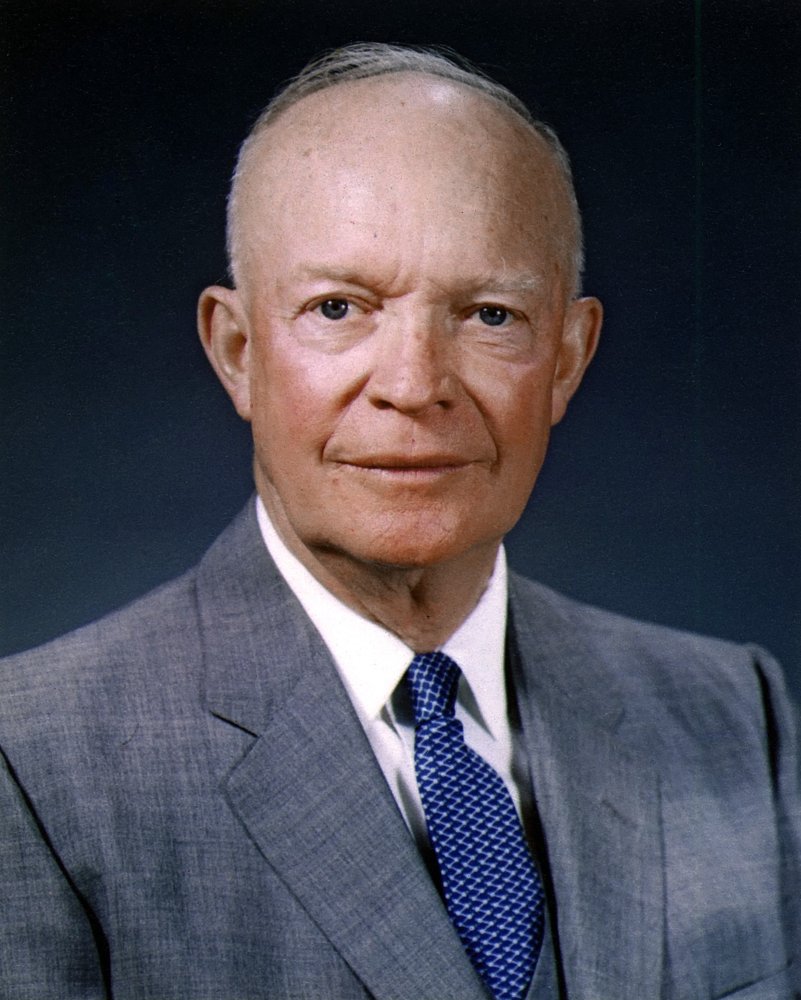
Photo: White House · Public domain. Eisenhower, official White House portrait, 29 May 1959; context image, not a photograph of the ranked address being delivered. Source frame and existing corrections retained; resized/recompressed without new crop, colorization or AI enhancement.
