
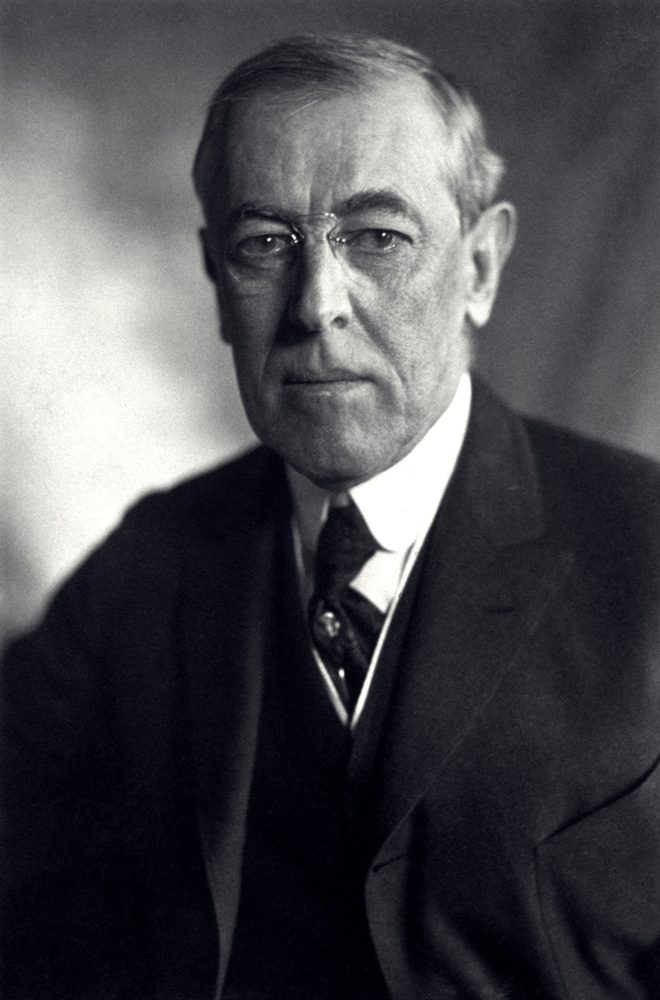
Woodrow Wilson presented the Fourteen Points to Congress on 8 January 1918. The address deserves to be read as a proposed political design rather than as a list of promises that history subsequently fulfilled. Its striking move is to connect particular territorial and diplomatic questions with a broader account of international order. A listener is invited to think about how a war might end, but also about what arrangements could make another settlement more durable. The resulting text is both an intervention in a specific conflict and an attempt to define the principles by which a future peace should be judged.
The numbered structure matters. It gives the appearance of a program that can be inspected point by point, rather than leaving the audience with a general expression of goodwill. Some points address rules of international conduct, while others concern particular places and political arrangements. That mixture is a productive source of tension. Broad principles sound universal; a specific settlement has to decide how they apply to populations, governments and competing claims. The address’s structure makes that movement visible, even where the proposed solutions leave difficult questions open. It is worth reading slowly enough to distinguish the general rule from the particular decision made in its name.
The argument and its structure
Consider how the document moves from diplomacy, navigation, economic barriers and armaments into geographical proposals. The sequence suggests that peace requires more than drawing new lines on a map. Rules, material relationships and expectations between states also matter. Yet the transition can also be questioned: does a clear principle produce a clear arrangement, or does its application introduce choices that the principle cannot settle by itself? That is an analytical question for the reader, not a reason to invent a hidden intention. The text’s value lies partly in allowing its own framework to be tested against the specificity of its proposals.
The final point calls for a general association of nations. Within the address, that proposal supplies an institutional conclusion to the preceding program. Instead of imagining that a declaration alone guarantees compliance, it points toward an organization that could provide mutual guarantees. A useful reading separates three stages: expressing a principle, negotiating an arrangement and creating an institution capable of maintaining it. Those stages are not interchangeable. The National Archives records that the later League of Nations emerged from the peace settlement and that the United States did not join. The address therefore offers an unusually clear example of the distance between presidential advocacy and a completed international order.
The ranking and a second reading
Ninth place reflects the document’s impressive architecture and the difficulty of making its numbered program feel like a fully resolved argument. Readers who prioritize a specific international agenda may put it above more lyrical or ceremonial addresses. The counterargument is that its apparent clarity can conceal how much interpretation is required to apply its language consistently. We do not settle that question by calling the entire proposal either a success or a failure. The ranking concerns what a reader gains from examining the address, including the gap between the scope of its ambition and the decisions that implementation would demand.
For a final reading, compare the opening claims about the kind of peace sought with the institutional proposal at the end. Ask which numbered points most directly connect those two levels and which leave the greatest distance between them. This turns a familiar historical label into a practical exercise in reading a political program. It also guards against treating the document as an automatic explanation of everything that followed the war. Negotiators, legislatures, governments and affected populations did not disappear when the president spoke. Would you rank an address more highly for the breadth of a proposed order, or for the precision with which it acknowledges the constraints on realizing that order?
Source: Original text / archival record 1.
Photo: Harris & Ewing · Public domain. Woodrow Wilson, Harris & Ewing portrait, 1919; existing tonal adjustments retained; context image, not a photograph of the ranked address being delivered. Source frame and existing corrections retained; resized/recompressed without new crop, colorization or AI enhancement.

