
John Kennedy’s inaugural address of 20 January 1961 is a particularly clear example of how a ceremony can become a sequence of political relationships. Rather than speaking only to the people gathered at the inauguration, the text addresses allies, newer states, people facing hardship, international institutions and adversaries before returning to the responsibilities of citizens. Its range is part of its appeal. A new administration introduces itself by arranging the world into audiences to whom different promises, requests and challenges are directed. The famous appeal to service gains meaning from that wider architecture rather than existing as an isolated slogan.
Begin with the contrast between continuity and renewal. The address marks a change of leadership while locating the new president within an inherited political tradition. That gives the speech a double task: it must sound new enough to justify the occasion and familiar enough to claim authority. Its movement between generations helps manage the tension. The argument is not simply that youth is preferable to age. It presents new officeholders as people taking responsibility for a commitment that predates them. A reader can test whether that framing makes the promised future more credible or merely gives aspiration an impressive historical setting.
The argument and its structure
The successive audiences provide the most useful route through the full text. Each change in addressee changes what a sentence is trying to accomplish. An assurance to an ally is not the same speech act as an invitation to an adversary. Nor is an appeal to citizens equivalent to a statement of what the government will do for them. Read the transitions aloud and notice how repeated forms help connect these different tasks. The design creates momentum while preserving a sense that the speaker is approaching distinct relationships, not repeating one undifferentiated promise to everyone.
The address also holds strength and negotiation in tension. Its account of danger does not eliminate the possibility of cooperation, while its willingness to negotiate is not presented as the abandonment of security. That balancing act offers more to examine than the best-known passage alone. The reader should ask how the speech connects these positions, where it gives reasons and where it relies on a shared sense of urgency. An inaugural establishes purposes and expectations rather than supplying a complete operational plan. It should therefore be judged as an opening argument, not treated as evidence that all its ambitions were later achieved.
The ranking and a second reading
Fifth place recognizes the address’s rhythmic control and unusually coherent movement among audiences. A reader who places the greatest weight on public service and the outward-facing role of an inaugural could make a persuasive case for a higher position. The counterargument is that its elegance can make unresolved policy difficulties sound more readily manageable than they are. Our ranking does not confuse memorable form with a guarantee of wise implementation. Its enduring reading value includes the opportunity to ask whether a well-balanced sentence adequately addresses a difficult relationship, or mainly makes the relationship feel momentarily balanced.
On a second reading, set aside the most familiar line and choose an earlier change of audience. Identify the relationship being defined, the commitment offered and the action requested in return. Then follow how that relationship prepares the later appeal to citizens. The exercise makes the address’s conclusion feel less detached from its preceding international argument. It also encourages a more demanding form of admiration: the whole structure must continue to work after the reader stops waiting for one quotation. Which contributes more to its force for you, the progression of audiences or the compact phrasing that makes those transitions easy to remember?
Source: Original text / archival record 1.
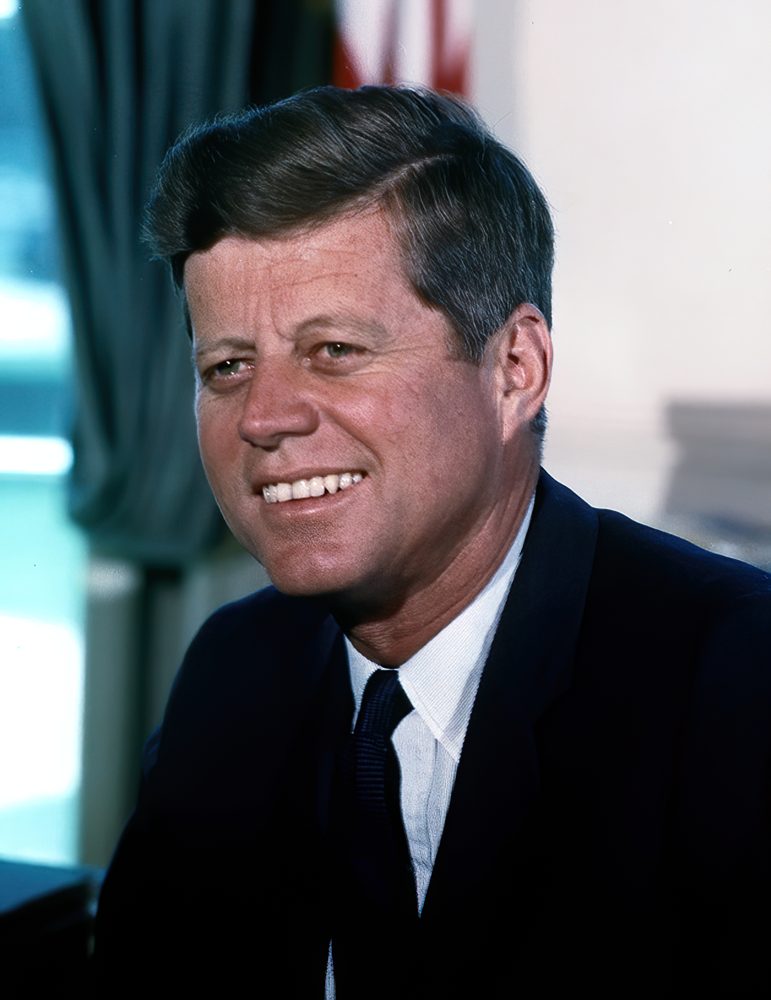
Photo: Cecil W. Stoughton / White House · Public domain. John Kennedy in the Oval Office, Cecil Stoughton, 11 July 1963; context image, not a photograph of the ranked address being delivered. Source frame and existing corrections retained; resized/recompressed without new crop, colorization or AI enhancement.

