
Franklin Roosevelt’s first inaugural, delivered on 4 March 1933, is often remembered as an attempt to defeat fear with confidence. The full address asks for more than a change of mood. It links diagnosis of an economic emergency with a case for action and for the authority needed to carry it out. That progression makes it a particularly useful inaugural to read closely. The speaker must persuade listeners that conditions are grave enough to require a different course, while also persuading them that the country retains the resources and institutions through which a different course can be attempted.
Notice the difference between reassurance and minimizing danger. The address does not make confidence depend on declaring the situation harmless. Instead, it separates material difficulties from the paralysis that can prevent a response. That is the rhetorical problem its famous opening tries to solve. A reader should then follow what the speech does with the space created by reassurance. Does it identify work to be done, distribute responsibility and explain what kind of action is required? The answer matters more than whether a familiar sentence still sounds stirring when detached from the political argument that follows it.
The argument and its structure
The economic discussion gives the address a vocabulary of practical failure and reorganization. Work, production, exchange and the uses of institutions are presented as political questions rather than conditions that the public can only endure. That helps turn an inaugural from a ceremony of succession into a proposed change in the relationship between government and an emergency. It is important, however, to distinguish the proposals in the address from a complete description of later policies. The text announces purposes and seeks room to act; it does not contain every law, administrative decision or consequence subsequently associated with the New Deal.
The request for extraordinary executive power is essential to a serious reading. Leaving it out makes the address sound like an uncomplicated lesson in optimism. Including it reveals a tension between the promise of decisive action and the question of how emergency authority should be justified. The speech uses a comparison with war to frame the scale of the response sought. A reader can understand the urgency of that analogy while examining what it authorizes and what limits remain visible. Admiring the address’s effectiveness does not require treating every request for broader power as self-justifying merely because the speaker invokes a crisis.
The ranking and a second reading
Fourth place recognizes the coherence of its movement from public confidence to institutional action. Readers who want a presidential address to confront a practical emergency may place it above the more compressed texts that follow. The strongest counterargument concerns how readily the language of necessity can narrow the apparent range of legitimate alternatives. That tension makes the inaugural worth studying rather than dismissing or celebrating automatically. Our ranking does not attribute economic recovery to one performance, nor does it turn the speech into contemporary financial advice. It evaluates how a president constructs a case that a frightened audience can follow and legislators must confront.
On a second reading, mark the point at which reassurance becomes a demand. Then identify whether the demand falls on citizens, Congress, the executive or more than one of them. This exercise reveals that confidence is not the address’s endpoint. It is preparation for accepting obligations and a proposed redistribution of initiative. The speech’s continuing interest lies in that relationship between emotional permission and institutional consequence. Which part carries the greatest weight for you: the account of paralysis, the call for useful work, or the attempt to justify the powers the president says he may need to overcome the emergency?
Source: Original text / archival record 1 · Original text / archival record 2.
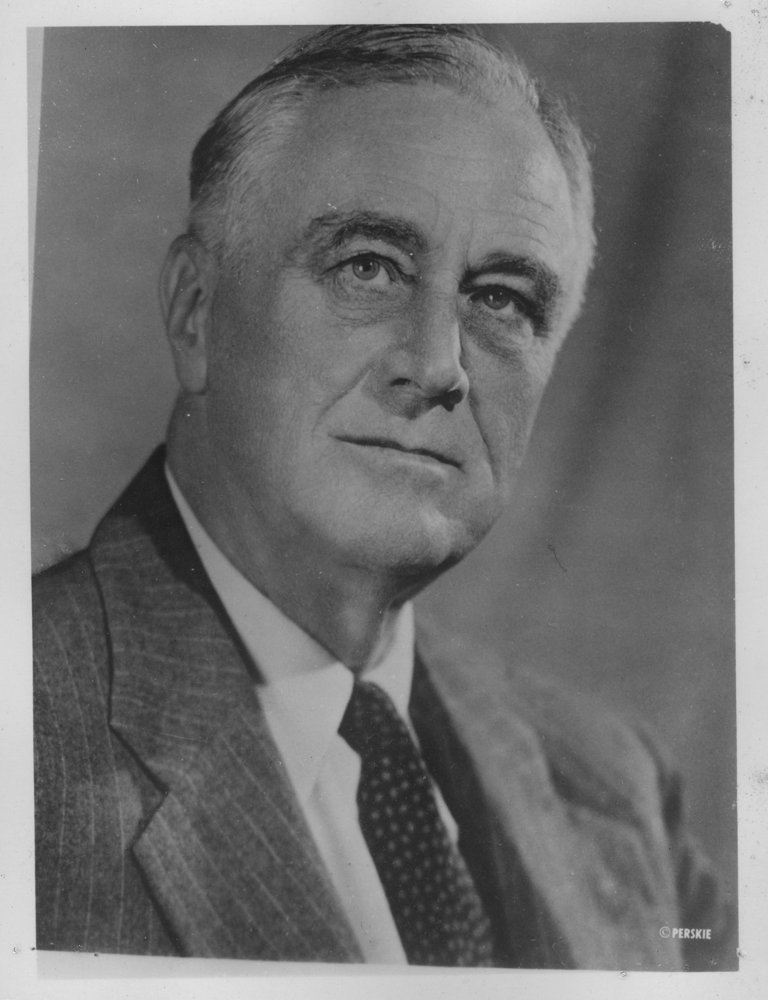
Photo: Leon Perskie · Public domain. Franklin Roosevelt, Leon Perskie portrait, 21 August 1944; context image, not a photograph of the ranked address being delivered. Source frame and existing corrections retained; resized/recompressed without new crop, colorization or AI enhancement.
