
Ronald Reagan’s 12 June 1987 address at the Brandenburg Gate demonstrates how a place can become part of a political argument. The wall is not merely background scenery. The speech makes a physical division serve as visible evidence for a claim about freedom and the character of political systems. Its best-known demand gains force from that relationship between location and proposition. The text asks listeners to imagine a change that could be recognized in the landscape itself. That gives an abstract disagreement a concrete form, while also making the address especially vulnerable to being remembered as one sentence without its wider argument.
The opening establishes more than one audience. Reagan speaks to those gathered in West Berlin, acknowledges people listening beyond the immediate crowd and addresses people in East Berlin despite being unable to stand among them. This expansion matters because a broadcast speech can travel where its speaker cannot. The location divides bodies while the address attempts to cross the division with words. Notice how the second-person audience changes as the text proceeds. A local welcome becomes an international statement, then a demand directed toward political leadership. The transitions help explain why the speech works differently from an ordinary domestic policy announcement.
The argument and its structure
The barrier supplies an organizing image. Rather than leaving freedom as an unlocated principle, the address returns to a place where movement is restricted and the restriction can be seen. That makes the central challenge easy to remember. It also simplifies a much larger political situation into an emblem. A careful reading can recognize the emblem’s power without treating it as a complete explanation of European history. The speech’s clarity is a rhetorical achievement; the accuracy and adequacy of its broader account remain questions to examine with evidence beyond the performance itself.
The full text places its demand among discussion of postwar rebuilding, economic arrangements, security and possibilities for a less divided future. These passages prevent the famous challenge from being the whole address. They show how the speaker connects an immediate image with a broader contrast between political and economic systems. A productive reading asks whether each connection is established or asserted. It is possible to admire the transition from place to principle while questioning a particular comparison. That distinction allows the reader to take political language seriously without making the ranking an endorsement of every policy position advanced by its speaker.
The ranking and a second reading
Seventh place rewards the unusually strong fit between setting, audience and memorable demand. Readers who value a speech’s public visibility and performative force could place it much higher. The opposing case is that its most recognizable line can overshadow the complexity of both the full text and the events it addresses. We do not claim the address alone brought down the Berlin Wall. That outcome cannot responsibly be reduced to a presidential performance. The ranking concerns the construction of the argument and its continuing value as something to read, rather than a measurement of how much historical change one sentence produced.
On a second pass, follow every movement between the city in front of the speaker and the larger world invoked around it. Ask when a visible object supports an argument and when it begins to stand in for conditions that require additional explanation. That is a useful lesson for reading political speeches at monuments, borders and disaster sites more generally. A location can sharpen a claim, but it does not relieve a speaker of the need for reasons. Would you rank this address primarily for the challenge at its center, or for the way it attempts to connect people separated from one another by the place where it was delivered?
Source: Original text / archival record 1.
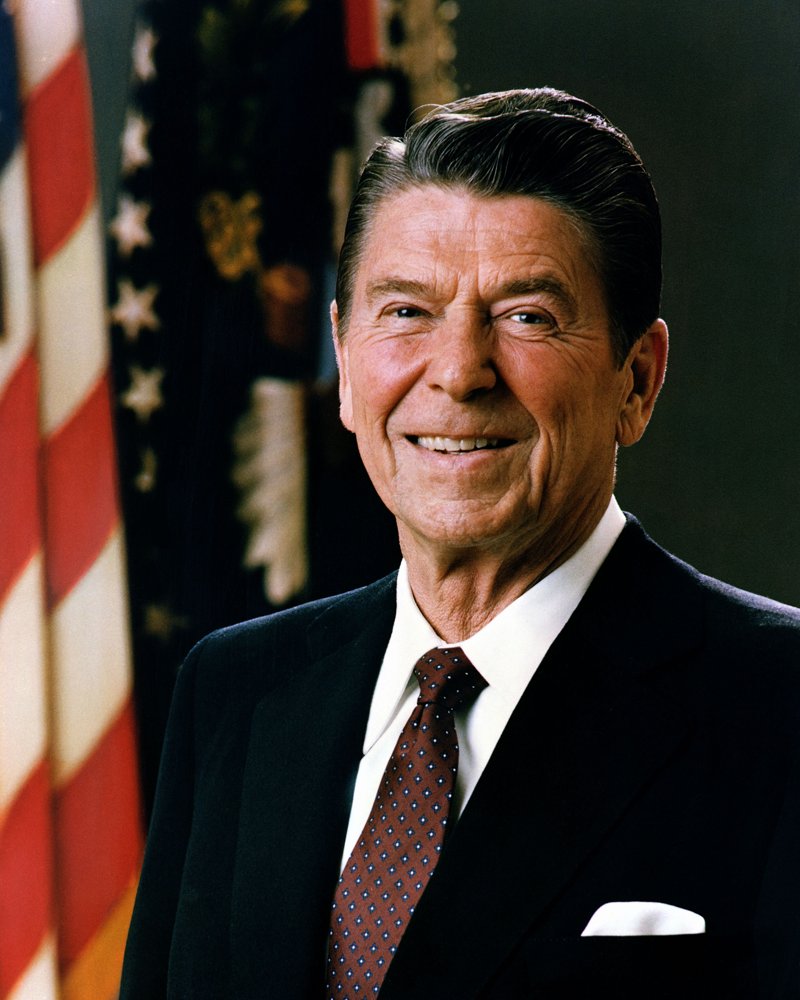
Photo: Michael Evans · Public domain. Ronald Reagan, Michael Evans official portrait, 1981; context image, not a photograph of the ranked address being delivered. Source frame and existing corrections retained; resized/recompressed without new crop, colorization or AI enhancement.
