
Lyndon Johnson’s 15 March 1965 message to Congress, The American Promise, connects the denial of voting rights with the nation’s own account of its purposes. Its force comes from refusing to treat the issue as an unfortunate matter at the edge of public life. The address puts it at the center of what the country claims to be. That move gives the speech both a moral frame and an institutional task. It asks Congress to act, but it also asks a national audience to reconsider what would count as failure even in the presence of wealth, technological achievement or success elsewhere.
The opening moves from recent events in Selma toward a wider statement of responsibility. The people demanding rights do not appear merely as passive beneficiaries of presidential generosity. Their protests and suffering are part of what has brought the government to this moment. That relationship is essential to a responsible reading. A speech delivered from a position of institutional power can acknowledge demands that originated outside that institution. The reader should therefore keep the civil rights movement’s agency in view rather than turning the address into a story in which a president alone discovers a problem and bestows its solution.
The argument and its structure
Johnson then connects political principle with the practical means by which it is obstructed. The discussion of registration barriers gives a broad promise a specific point of contact with lived experience. This is one reason the full address matters more than a familiar extract. General agreement that equality is desirable can coexist with procedures that deny it. The speech attempts to close that distance by describing the difference between a right announced and a right made usable. Reading this as historical argument does not supply current voting instructions, whose rules and procedures require their own authoritative, up-to-date sources.
The address’s structure also distinguishes persuasion from enactment. Johnson speaks about legislation to be submitted and calls for congressional action. He does not make the existence of a speech equivalent to a completed law. That distinction helps readers understand the institutional work a message to Congress performs. The rhetoric identifies an obligation and argues that existing arrangements are inadequate; legislation and implementation are further tasks. A good reading asks how the moral frame supports the practical proposal, and whether the proposal addresses the barriers described. The force of the appeal depends on the connection between those levels.
The ranking and a second reading
We rank the address sixth for its combination of moral clarity, concrete obstacles and an identifiable legislative purpose. Readers who prioritize the relationship between public language and equal citizenship could place it among the top entries. The counterargument is that the inaugural and farewell texts above it achieve a more compressed or formally distinctive shape. That is a judgment within our criteria, not a ranking of the importance of voting rights against other subjects. A speech can address an issue of fundamental consequence without automatically taking first place in a list concerned with how political arguments are constructed.
For a final reading, mark each passage that changes the scale of the issue: a local event becomes a national problem, a founding promise becomes an obligation, and an obligation becomes a request for action. Then ask which transition is most persuasive and why. This method keeps the address connected to the people and institutions around it. It also guards against mistaking a moving performance for proof that a struggle ended when the speaker finished. Does the speech’s greatest strength lie in its language of common purpose, its account of exclusion in practice, or the way it makes one require a response to the other?
Source: Original text / archival record 1.
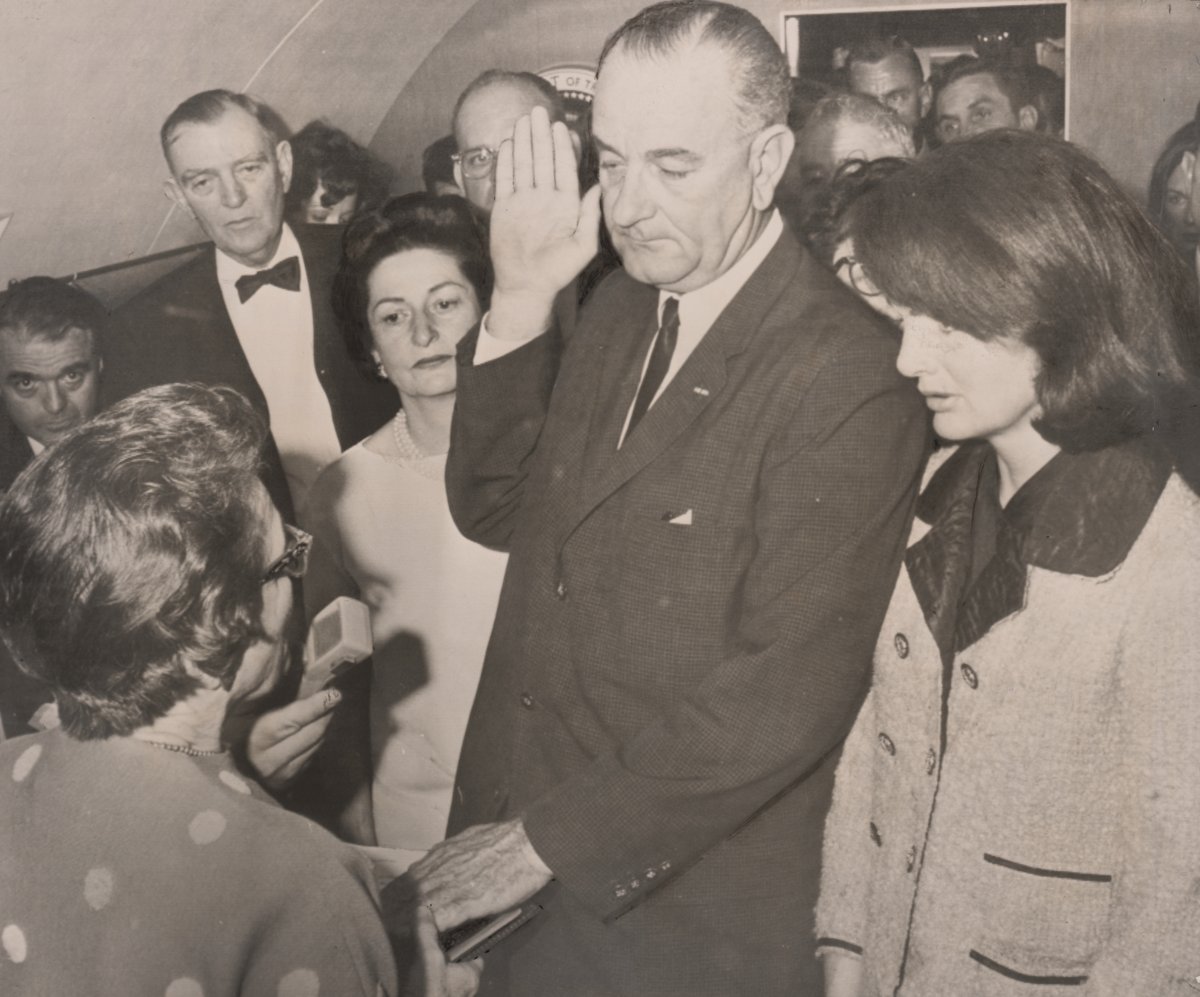
Photo: Cecil W. Stoughton · CC0. Johnson with Lady Bird Johnson and Jacqueline Kennedy, 22 November 1963; earlier historical context; context image, not a photograph of the ranked address being delivered. Source frame and existing corrections retained; resized/recompressed without new crop, colorization or AI enhancement.
