
Pioneer 10 ranks ninth for turning the journey to Jupiter into a measured reality. NASA launched it in March 1972, and it became the first spacecraft to fly through the main asteroid belt and encounter Jupiter. The mission established a route into the outer planetary system before the more expansive Voyager journeys. It is worth studying as reconnaissance rather than as a smaller version of a later mission. An initial encounter must answer practical and scientific questions about what lies along the route, what the instruments experience and what can be learned during the available passage. That pioneering role is its strongest claim to a higher position.
The asteroid-belt crossing is a useful corrective to a familiar visual misconception. A mission trajectory through the belt should not be imagined simply as a movie chase between tightly packed giant rocks. The spacecraft's measurements are more informative than that cinematic shorthand. Consider what a planner would want to know about the environment and how an instrument could sample it. You do not need to calculate a complete trajectory to understand the principle: exploration tests expectations by going somewhere and measuring the conditions encountered. A successful crossing supplies evidence and experience for later journeys, rather than proving that every possible route or future flight is identical.
A first passage through Jupiter’s environment
Jupiter also introduces the distinction between a planet's visible appearance and its surrounding environment. Pioneer 10 carried instruments for imaging and for studying particles, fields and other conditions. The mission therefore cannot be summarized entirely by its most attractive picture. A camera shows a different aspect of the encounter from a detector responding to the environment around the spacecraft. For a beginner, choose one image and one non-image measurement described in NASA's mission account. Ask how the two contribute to a fuller description of Jupiter. That exercise makes the spacecraft a traveling laboratory rather than merely a remote camera sent to collect a souvenir.
Its energy system provides another approachable engineering question. Farther from the Sun, a mission's power supply must match its environment and intended work. Pioneer 10 used radioisotope electrical power, which converts heat from radioactive decay into electricity; it was not a nuclear reactor driving the spacecraft like a fictional engine. Distinguishing electrical power from propulsion helps make mission diagrams readable. An antenna communicates, instruments measure, and the power system supports their operation. Those functions interact but should not be blended into one vague idea of a powerful machine. The clear division of jobs lets you understand why design choices become scientific possibilities and limitations.
Power and the end of communication
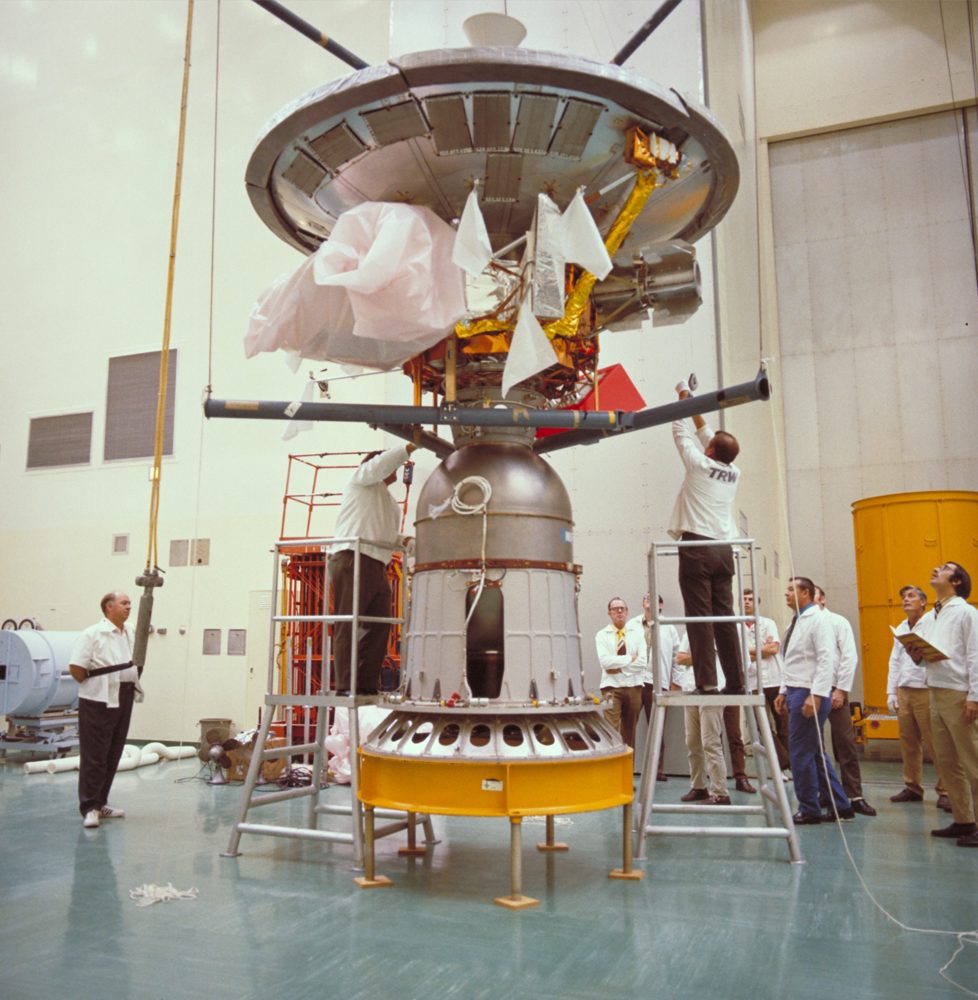
The mission's long history also needs a careful endpoint. NASA records the last received signal in January 2003. Its continued outward trajectory is different from continued operation or communication. A spacecraft can remain physically in motion after its useful radio contact ends. That distinction is especially valuable when comparing Pioneer with Voyager, whose current status is described separately on NASA's live mission pages. Avoid treating an outward arrow on a diagram as a promise that data are still arriving. The archive photograph here documents preparation of the hardware on Earth, providing a grounded alternative to an unlabeled illustration of a probe flying past a giant planet.
Ninth place values the opened route and the first Jovian reconnaissance, while the missions above offer broader or more sustained investigations. Pioneer 10 can rank higher for a reader interested in how later exploration becomes possible. Compare its encounter with Galileo's orbital study and Voyager's multi-planet program. The scientific story then becomes a sequence of increasingly specific questions, not a contest in which a later spacecraft erases its predecessor. Its lasting lesson is that a successful first passage changes what can be planned next. A new destination is not simply reached; it becomes an environment for which people have actual observations rather than only expectations.
Photo: Pioneer 10 delivered to NASA, 26 February 1972. NASA Ames Research Center · Public domain. Resized and recompressed without cropping; source license retained.

