
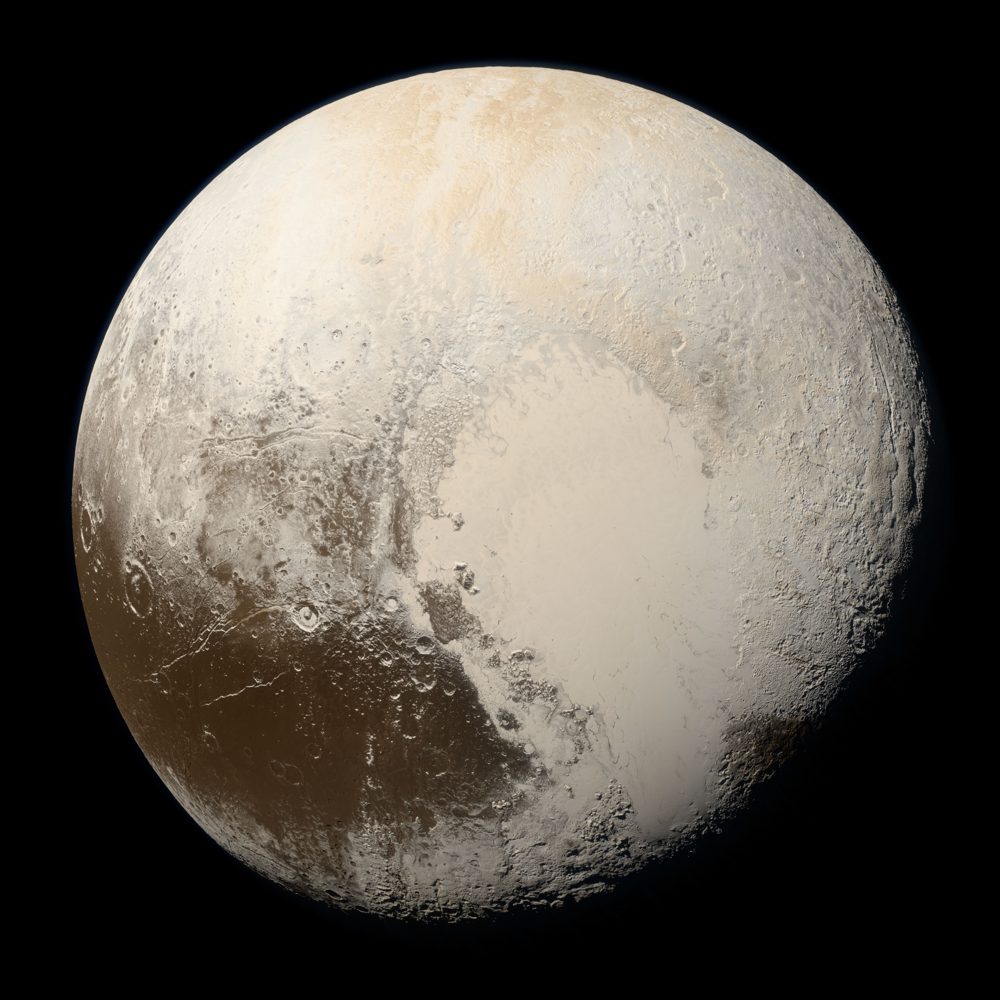
New Horizons ranks fifth for turning Pluto and its surroundings into a close-up scientific encounter, then extending the journey to another small world. The spacecraft launched in January 2006 and passed Pluto on 14 July 2015. It later encountered the Kuiper Belt object Arrokoth in 2019. These are flybys, not orbital visits or landings. The distinction is important to its appeal: a carefully prepared passage can produce a major change in understanding even when the spacecraft does not remain beside its target. It is a strong choice for readers interested in how a distant, faint object becomes a landscape without ever becoming a destination people can casually revisit.
Pluto is a dwarf planet, but the classification does not make its geology a minor subject. The returned views make it possible to ask about different terrains rather than treat the world as a single unresolved point. An image can reveal forms and contrasts that invite explanation, while composition and other measurements help test the possibilities. Avoid reading a colorful map as if it labels its own materials automatically. The productive question is which observations support a particular interpretation. That approach preserves the wonder of the encounter while moving beyond a simple before-and-after story in which a sharper photograph is assumed to provide every answer by itself.
Planning a moving encounter
The mission also helps explain why preparation is central to a flyby. Observations have to fit a moving geometry and the spacecraft's capabilities, while communication takes place across enormous distance. An encounter image is therefore part of an organized measurement program rather than an accidental snapshot. You can understand that without inventing a last-second remote-control action from Earth. A useful exercise is to follow a published sequence and identify how perspective changes as the spacecraft approaches and departs. The different views tell you something about the encounter itself, and they remind you that a later image is not simply the same photograph made more detailed.
Arrokoth gives the entry a second, distinct scientific subject. It should not be presented as another name for Pluto or one of Pluto's moons. Comparing two targets within the wider Kuiper Belt turns the journey into more than a single famous date. Ask what the mission could compare across the encounters and which questions remained particular to each object. The value comes partly from seeing diversity within a region often represented as a distant band on a diagram. That is why we place New Horizons above Dawn under our overall criteria, while recognizing that prolonged orbital study of two bodies may be a better starting point for a different learner.
A second Kuiper Belt target
The image accompanying this page is a processed view of Pluto assembled from New Horizons observations, with its source and date identified. The spacecraft is not visible because the picture was taken by its instruments, not by a camera following it. Keep that viewpoint clear when comparing it with artists' concepts elsewhere. NASA's current mission page provides the appropriate status and subsequent research context; an old image cannot establish today's exact distance, remaining instrument plan or future encounter schedule. Those operating details change, whereas the historical dates and the distinction between a flyby and an orbit remain useful foundations for reading the mission correctly.
Fifth place rewards a profound change in the accessibility of outer Solar System science. New Horizons can be your first choice if you want to understand how small-world exploration extends beyond the familiar planets. Compare its short encounter windows with Galileo's repeated moon studies and Cassini's long residence at Saturn. The comparison highlights a trade-off, not a hierarchy in which one kind of mission is always superior. Its lasting lesson is that a brief passage can create a deep scientific archive when the questions, instruments and observation plan are aligned. The spacecraft moves on, but the work of interpreting what it recorded continues.
Source: NASA.
Photo: Processed New Horizons view of Pluto, 14 July 2015. NASA/Johns Hopkins University Applied Physics Laboratory/Southwest Research Institute/Alex Parker · Public domain. Resized and recompressed without cropping; source license retained.

