
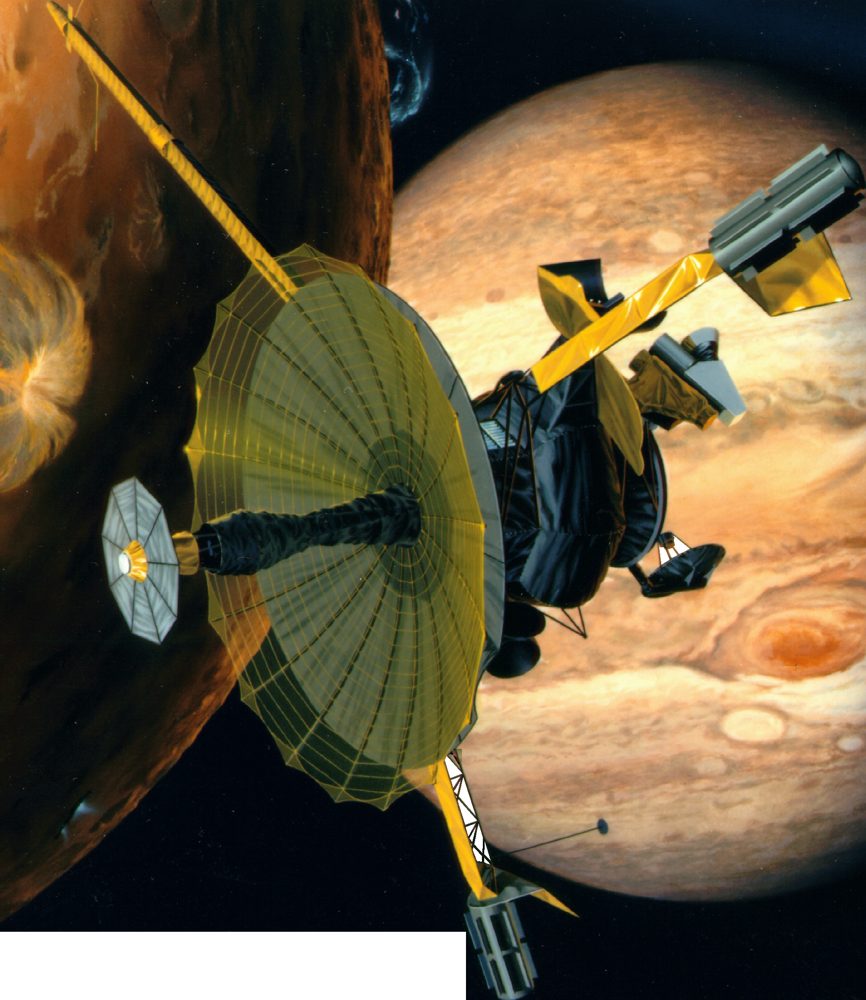
Galileo takes fourth place for converting Jupiter from a destination visited in passing into a planetary system investigated repeatedly. The mission reached Jupiter in 1995 and ended in 2003. It combined an orbiter with an atmospheric probe, linking measurements of the giant planet with close study of its moons. That arrangement makes it a particularly useful bridge between Pioneer 10's first reconnaissance and the later sustained exploration of Saturn by Cassini. Jupiter is not simply a large colored sphere in this story. It is an environment containing an atmosphere, fields, rings and moons whose relationships become more interesting when examined together over time.
Europa supplies one of the clearest examples of evidence extending beyond a surface photograph. Galileo's observations support the interpretation of a liquid ocean beneath the moon's icy exterior. The ocean is not an open blue patch visible in an ordinary camera image. The claim draws on the relationship between observed features and other measurements, including magnetic data. That distinction is worth preserving every time the result is retold. A reader can be excited by an inferred ocean while still asking how the inference is supported. The mission becomes more scientifically compelling, rather than less, when the reasoning is not replaced by a misleading image caption.
Moons as scientific worlds
Ganymede adds another important difference among moons: Galileo found that it possesses its own magnetic field. A group portrait of Jupiter's large satellites can make them look like four comparable decorative spheres, yet their properties are not interchangeable. Our guide to the Solar System's largest moons provides a useful introduction to those identities. With Galileo, ask how observing a surface, a field or a surrounding environment leads to different kinds of conclusions. The question makes it easier to appreciate why a mission carries several instruments and returns to several targets instead of trying to reduce a whole system to one spectacular picture of its largest planet.
The mission also illustrates adaptation when hardware does not work as intended. Galileo's high-gain antenna did not deploy fully, limiting the communications system. NASA describes changes in onboard processing and ground operations that helped recover a substantial scientific return. This is not a claim that the problem had no cost or that every original objective became possible. It shows that mission success can involve reorganizing the use of available capabilities. A beginner can compare the intended design with the eventual method and see engineering as an active part of the scientific story, not merely a preliminary hurdle that disappears after a launch photograph.
Adaptation and a deliberate ending
Galileo's deliberate end at Jupiter is connected to the care taken around potentially interesting environments. NASA explains the final impact as protection for Europa, where an ocean had become a serious scientific possibility. An end-of-mission decision can therefore be part of responsible exploration rather than simply an unfortunate closing scene. Keep that historical action distinct from a claim that life was found. The illustration here is explicitly an artist's representation of the spacecraft, not a camera view from beside it in space. Use the primary mission account for the observations, and the artwork only to understand the machine's appearance and setting.
Fourth place recognizes an especially rich combination of planetary and moon science, sustained observation and technical adaptation. Galileo can rank higher for a reader fascinated by ocean worlds or by the question of how several measurements support an interpretation. Cassini has the edge in this guide for the breadth of its Saturn-system record, while Voyager wins for its wider reach across planetary systems. Those comparisons should sharpen the reasons to read, not diminish Galileo's achievement. Its lasting lesson is that a planet's companions can become major scientific worlds in their own right, and an apparently solid icy surface can point toward questions that photographs alone cannot settle.
Source: NASA.
Photo: NASA artist’s concept of Galileo; creation date unspecified. NASA · Public domain. Resized and recompressed without cropping; source license retained.

