
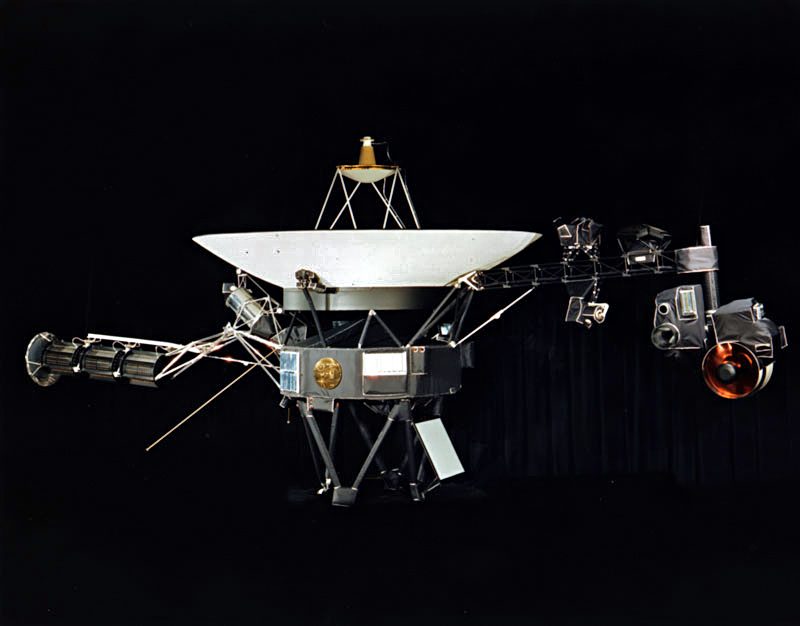
Voyager wins this guide for combining a remarkably broad planetary journey with a later investigation of the environment beyond the heliosphere. The two spacecraft launched in 1977 and count here as one program. Both explored Jupiter and Saturn, while Voyager 2 continued to Uranus in 1986 and Neptune in 1989. NASA still identifies Voyager 2 as the only spacecraft to have studied those two planets up close. This is not a ranking based simply on how far a machine traveled. It rewards the way one program connected several planetary systems, changed scientific expectations and then continued asking a different kind of question beyond its original destinations.
Jupiter's moon Io provides a powerful example of that change. Voyager observations revealed active volcanism on another world, challenging the idea that small distant moons must be quiet relics. The importance lies in the observed activity and the questions it opened about energy and planetary systems. An image may show a particular feature at a particular time, while an explanation brings it into a broader physical account. Keep those levels distinct. A discovery becomes more useful when you can say what the observation established and why it changed the next question, rather than only remembering that the picture looked more surprising than an earlier artist's illustration.
Different worlds, different evidence
The later encounters demonstrate variety among giant planets and their surroundings. Voyager 2's Uranus and Neptune passages supplied close-up views of worlds that are not simply smaller copies of Jupiter or Saturn. NASA's current planetary pages distinguish this reconnaissance from later remote observations. That matters when reading a modern image caption: a picture made with an Earth-based or space-based telescope is not another spacecraft flyby. A beginner can compare the kinds of detail and the perspectives available through each method. The program's reach gives the comparison unusual force, because the same broad journey encountered several different environments rather than returning to only one familiar target.
Voyager's interstellar phase requires another boundary to be stated carefully. NASA records Voyager 1 crossing the heliosphere's boundary in 2012 and Voyager 2 in 2018. The heliosphere is the region shaped by the solar wind and magnetic field; crossing its edge is not the same as passing every distant object gravitationally associated with the Sun. Avoid saying that the spacecraft have passed the entire Oort Cloud or that the Sun's gravity suddenly stops there. The mission's value comes from measurements of a changing environment, not from a simplified border drawn as if the Solar System were a country with one unambiguous fence.
A boundary and a wider perspective
The Pale Blue Dot offers a different but connected lesson. Voyager 1's 1990 image shows Earth as a tiny point within an instrument-produced scene. It is a scientific observation with a documented viewpoint and a powerful cultural afterlife, not proof that a person stood beside the probe with a camera. The hardware photograph accompanying this entry introduces the spacecraft on Earth. Together, the records connect a machine, an observation and an interpretation of our place in space. Our largest-moons guide supplies a useful next step for the planetary encounters, while NASA's current Voyager pages should be used for operating status rather than old distance figures repeated without dates.
First place is our choice for breadth, enduring reframing and a rich record from which to learn. Cassini-Huygens can win on depth within one system, and Curiosity on a connected surface investigation of ancient habitability. Their competing cases remain strong because the missions answer different questions. Voyager's lasting lesson is that exploration can change both the map and the categories used to read it: moons become active worlds, giant planets reveal distinct systems, and a planetary journey becomes an environmental investigation. Which would you choose as your starting point: that breadth, Cassini's sustained Saturn study or Curiosity's patient work through the rocks of Mars? The best answer depends on the question you want to follow next.
Photo: Voyager hardware; NASA archive, 1977. NASA/JPL-Caltech · Public domain. Resized and recompressed without cropping; source license retained.

