
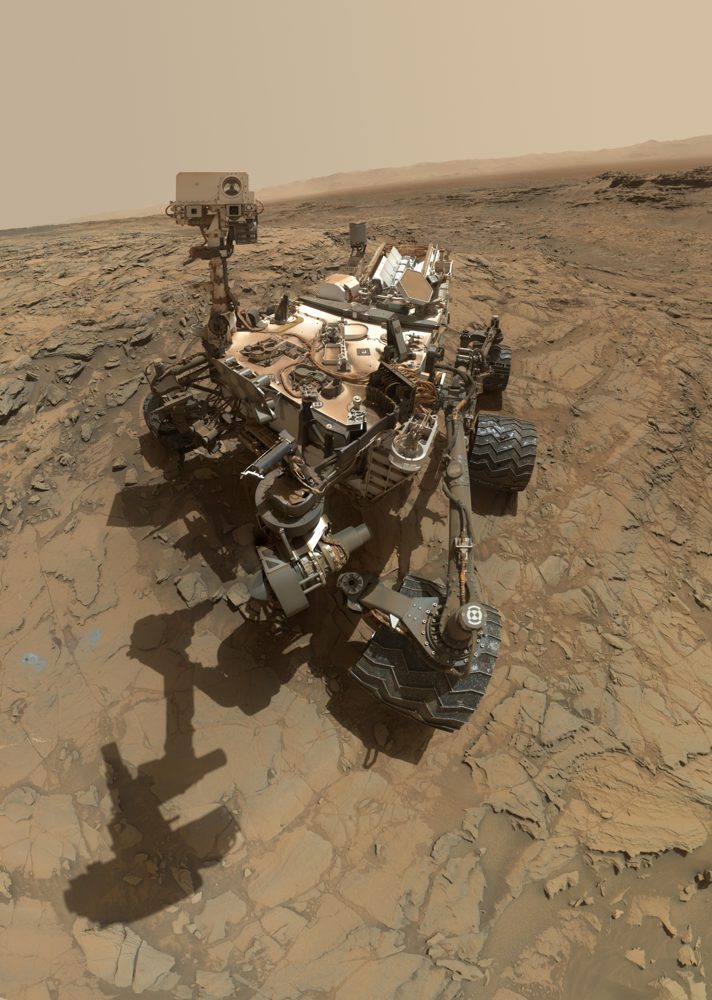
Curiosity, the rover at the heart of Mars Science Laboratory, ranks third for making an ancient environment into an extended ground-level investigation. It landed in Gale Crater in August 2012 after launching in November 2011. NASA's mission account describes chemical and mineral evidence that past Martian environments could have supported microbes. That is a statement about environmental suitability, not proof that organisms were present. The rover's strength as an introduction lies in the connection between a place, its rock record and measurements taken along a route. A reader can follow the scientific question through changing terrain instead of treating every new image as an unrelated Martian postcard.
The difference between habitability and life should remain visible throughout the entry. A setting can possess conditions relevant to life without showing that life actually developed there. Likewise, an organic molecule is a chemical finding that requires context; it is not automatically a fossil or a biological signature. This is not a reason to make the mission sound less exciting. It explains what its evidence contributes to a larger investigation. When reading a result, identify the sample or observation, the instrument involved and the claim being made. If a headline has skipped from useful chemistry to living creatures, return to the primary account before repeating it.
Habitability, movement and context
Mobility changes the way a surface mission can frame a question. Curiosity can compare observations from different points along its journey, connecting local rock features with a broader geological setting. That does not mean a rover sees all of Mars or that a selected sample is automatically representative of an entire planet. It means that location becomes part of the evidence. A useful reading exercise is to follow a route map alongside a sequence of findings. Ask why the team investigated a particular area and what a later location added. The movement makes sense as a scientific strategy, not merely as a distance record to be celebrated without context.
There is a clearly dated 2026 example. NASA reports that Curiosity reached an elevation gain of one kilometer on 26 August 2026 during its journey from Gale Crater up Mount Sharp. Elevation gain is not the same measurement as total driving distance. Keeping the two apart makes the milestone more informative: the route passes through a changing geological setting, rather than simply accumulating horizontal kilometers on a flat map. We include the current notice as context checked for this article, not a forecast of the rover's future condition. Operational status and the next planned drive should always be read from the current official mission updates.
A dated milestone and a constructed self-portrait
Curiosity's self-portraits are also an excellent lesson in how a mission picture is produced. The Big Sky view used here combines images acquired by a camera on the robotic arm in October 2015. It is not a single photograph taken by another robot standing nearby. The source describes the component views and the assembly, including why the arm does not appear in the final image. That processing does not make the view worthless; it tells you what kind of record you are examining. Read the caption before treating an apparent perspective as a literal description of where an imaginary photographer must have stood.
Third place rewards the accessible connection between landscape, instruments and an evolving question about ancient conditions. Curiosity can be the best starting point for someone who prefers to learn through geology on a surface rather than through distant planetary flybys. Cassini and Voyager take the top positions for broader system-level reach in our comparison, but that does not reduce the depth of a local investigation. The mission's lasting lesson is that a rock becomes evidence through context and measurement. A compelling discovery is not simply an unusual shape in a viral image; it is an observation connected carefully to the question the instruments were designed to investigate.
Photo: Curiosity Big Sky self-portrait mosaic; observations 6 October 2015 PDT. NASA/JPL-Caltech/MSSS · Public domain. Resized and recompressed without cropping; source license retained.

