
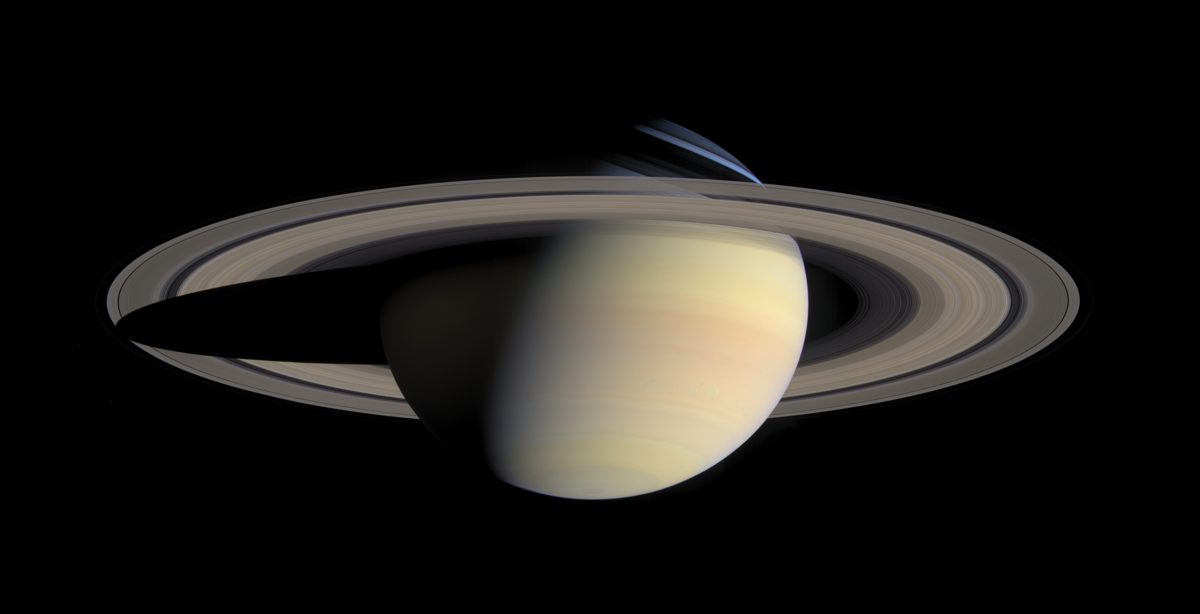
Cassini-Huygens ranks second for the depth and variety of its exploration of Saturn's system. The international mission was a collaboration among NASA, the European Space Agency and the Italian space agency. It launched on 15 October 1997; Cassini began orbiting Saturn in 2004, and the mission ended in September 2017. The orbiter and the Huygens probe belong together in this entry because the combined project links prolonged system-wide observations with an atmospheric descent and surface landing on Titan. For a reader who wants to spend time with one planetary family, it offers the strongest alternative to Voyager's much wider journey.
The rings provide an immediate visual entrance, but their scientific value is not limited to an attractive outline around a planet. Different observing angles and repeated views allow questions about structure and change that a single distant picture cannot answer. Read the acquisition and processing notes for a mosaic before interpreting every color or shadow. The Saturn image used here combines many frames from October 2004. It is a carefully constructed observational view, not a photograph taken by a second spacecraft following Cassini. Understanding the construction helps you ask which features belong to the object, which to illumination and which to the way the measurements are displayed.
Titan, Enceladus and complementary observations
Huygens adds a different scale of evidence. ESA's probe descended through Titan's atmosphere and landed on 14 January 2005. The event should not be described as Cassini itself landing or as a human expedition to a moon. It is a linked part of the same international mission, with its own instruments and observation sequence. Comparing an orbital interpretation of a world with measurements during descent and at the surface makes the project especially valuable for beginners. A landscape can be studied from several perspectives, and the scientific benefit comes partly from connecting those perspectives rather than assuming that one replaces all the others.
Enceladus supplies another major route into the mission's legacy. Cassini studied plumes of ice and vapor and helped establish the importance of an ocean beneath the moon's exterior. That is not a discovery of life, and a plume image is not a direct photograph of organisms or an exposed global sea. The useful question is how measurements of material and the moon's behavior contribute to an account of its interior. Our largest-moons guide gives additional background for comparing Titan with other worlds, while this mission also reminds us that physical size alone does not determine a body's scientific importance or its capacity to change a research agenda.
Why a finished mission keeps teaching
A completed mission can keep producing new research. Cassini's final plunge into Saturn in 2017 ended spacecraft operations, but the observations remain available for continued interpretation. Distinguish the date a measurement was made from the date a paper or article analyzes it. This is especially helpful when a current headline discusses a spacecraft that no longer exists as an operating platform. The anniversary of its October launch adds a dated reason to revisit the story in this season; it is not evidence that every rise in related searches was caused by that anniversary. The facts of the mission and the motives of people searching are separate questions.
Second place reflects the exceptional depth of a single-system investigation. Cassini-Huygens could reasonably win for a reader who values long residence, an atmospheric probe and the linked study of a planet, rings and diverse moons. Voyager takes first because our criteria give an edge to its reach across several planetary systems and its later frontier measurements. The choice is editorial rather than a measurement of scientific worth to a decimal place. Cassini's lasting lesson is that repeated attention changes what can be asked. A beautiful planet becomes a dynamic family of environments, and a finished mission can leave questions that continue to shape exploration long after its final transmission.
Photo: Cassini mosaic of Saturn, 6 October 2004. NASA/JPL/Space Science Institute · Public domain. Resized and recompressed without cropping; source license retained.

