
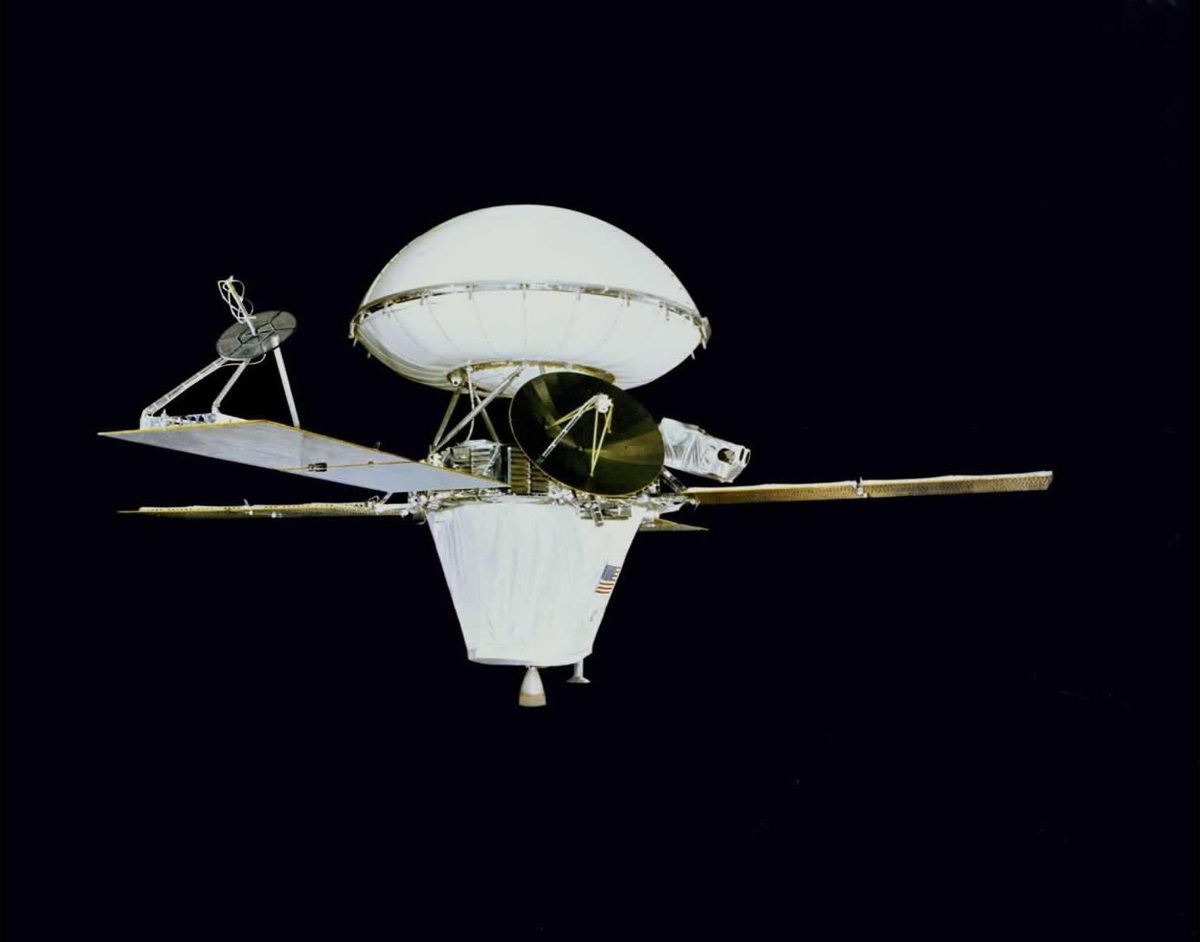
The Viking program ranks eighth for bringing sustained U.S. exploration onto the Martian surface while retaining an orbital perspective. Viking 1 landed in July 1976 and Viking 2 in September of the same year. Each mission combined an orbiter and a lander, so the pair counts as one program in this countdown. The design gives a beginner an unusually clear comparison between viewing terrain from above and investigating a particular place on the ground. In 2026, NASA marks fifty years since the first landing. That anniversary is a useful reason to revisit the evidence, rather than merely celebrate an old photograph without asking what the instruments were built to determine.
A surface panorama changes the relationship between scale and experience. Distant terrain becomes a place with nearby rocks, a horizon and parts of a machine within view. Yet a lander's location remains one location. The picture does not represent every Martian landscape, and the feeling of standing there is not the same as having a complete geological interpretation. Compare a surface image with an orbital one in the official archive. Ask which features you can locate in each and what remains outside the frame. The paired view explains why an exploration program can benefit from different platforms even when they study the same planet at nearly the same time.
Working on the Martian surface
Viking's biology experiments are central to its scientific importance and to the care needed in describing it. NASA's current account says the experiments found unexpected chemical activity but did not provide clear evidence of living microorganisms near the landing sites. That is a more precise conclusion than either announcing Martian life or claiming that all future searches were settled forever. A test has a method, a sample and an interpretive problem. For a learner, the useful question is why a result can be scientifically important even when it does not deliver the simple yes or no that a headline might prefer.
This makes Viking a strong entry point into the difference between a search objective and a discovery. Sending instruments to look for something is not evidence that the thing was found. Conversely, an inconclusive or unexpected outcome can expose a more complicated environment than the experiment's designers had anticipated. You can appreciate the ambition while examining the limits. Write two sentences: one describing what the mission sought and another describing what the official account says the results established. If the sentences have quietly become identical, check the wording again. That small discipline is useful far beyond Mars because public descriptions often blur a scientific question with its hoped-for answer.
What the biology experiments established
The program also connects equipment with the persistence of observation. The landers operated beyond their original planned lifetimes, and their measurements belong to particular sites and periods. An archive combines records created on different days and by different instruments. Keep those identifiers when following a modern retrospective. Our image may show hardware or a mission view, as its caption specifies; it is not a new 2026 photograph of a working lander. The anniversary adds context to the act of reading today, while the observation date remains attached to the evidence. Preserving both dates keeps commemoration from rewriting the mission as a current event.
Eighth place recognizes a major change in how Mars could be investigated, with the higher entries offering stronger combinations under our criteria. Viking can move upward for anyone interested in experimental design, the search for life or the relationship between local and global observations. Compare it with Curiosity, which addresses past environmental suitability through a moving geological investigation. Neither mission should be reduced to a slogan about life. Their value grows when you see how the questions and tools differ. Viking shows that a difficult scientific result can remain productive for decades, especially when later readers resist turning uncertainty into either triumphal certainty or a dismissive claim that nothing was learned.
Source: NASA.
Photo: Viking orbiter–lander configuration; NASA archive, 1975. NASA · Public domain. Resized and recompressed without cropping; source license retained.
