
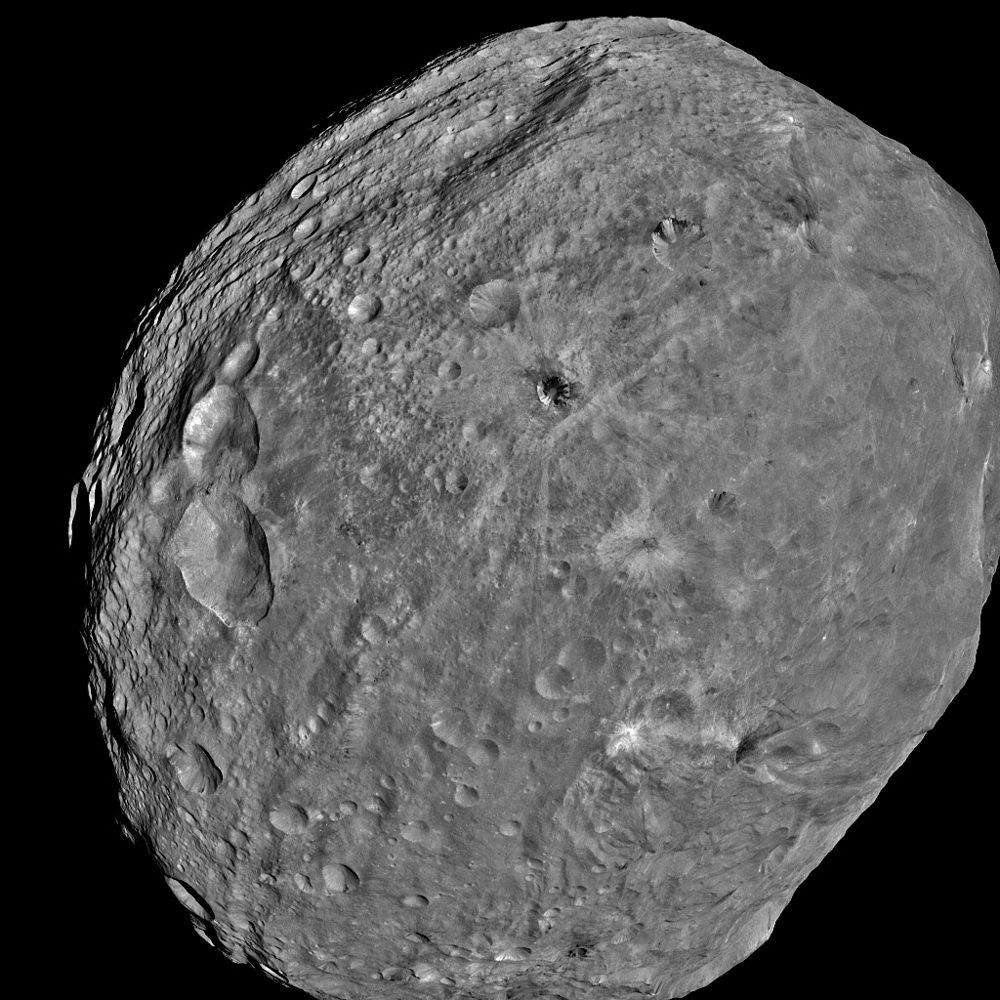
Dawn ranks sixth for making a direct comparison between two substantial worlds in the main asteroid belt. It launched in 2007, investigated Vesta and later Ceres, and ended its mission in 2018. Vesta is a giant asteroid and Ceres a dwarf planet; their shared neighborhood does not make them interchangeable. Dawn became the first spacecraft to orbit two extraterrestrial bodies, using ion propulsion as a central part of the journey. That combination gives a reader two linked stories: how a spacecraft can change its destination and how studying different objects with one mission can sharpen the questions asked about both.
The comparison is the reason to start here rather than simply browse one attractive image. Ask which features can be meaningfully compared and which require local context. A crater, a smooth region or a bright deposit is an observation to investigate, not proof that every small body has the same history. The program demonstrates why the phrase asteroid belt should not conjure a population of identical rocks. Its large members can preserve distinct geological and chemical stories. A beginner can keep a two-column notebook for Vesta and Ceres, recording one visible feature, one instrument-based conclusion and one uncertainty for each rather than forcing them into the same description.
Two worlds, different questions
Ceres provides a particularly accessible example through the bright material in Occator Crater. The appearance draws attention, but brightness alone does not identify the substance. The scientific account connects imagery with evidence about material and processes. That distinction is the productive part of the story: an image supplies a striking question, then other measurements help develop an explanation. Avoid presenting a luminous-looking region as a city, a lamp or a direct view into an ocean. You can appreciate how unusual it looks while asking a much more useful question about what the spacecraft actually measured and how researchers tested competing interpretations.
Ion propulsion is equally easy to misunderstand if described only as a futuristic engine. Its relevance lies in what the mission could accomplish over time, not in an imaginary cinematic burst of acceleration. Electrical power and propellant support a system whose operation changes the trajectory gradually. For this guide, the key point is that propulsion helped make prolonged visits at two bodies possible. You do not need to reproduce an engineering design to see the scientific consequence. The mission's questions were connected to the machine's capabilities, and the eventual comparison depended on planning a journey that did more than pass both objects on the same fast flyby.
Read the archive beyond the image
The end of the mission also reveals a distinction between kinds of fuel. NASA explains that Dawn ran out of hydrazine needed to control its orientation, leaving it unable to keep communicating as required. That is not the same statement as saying the spacecraft suddenly vanished or that its scientific record ceased to exist. The mission remained a physical object in orbit around Ceres after operations ended. When exploring the archive, keep an end-of-operations date beside the continuing research use of the observations. The life of a scientific data set can extend well beyond the active life of the instrument that produced it.
Sixth place values the paired-world experiment and the close relationship between engineering and comparison. It can rank higher for a reader interested in small bodies or the formation and later histories of planetary building blocks. New Horizons, above it, supplies a different approach to a distant small-world system; MESSENGER offers a sustained orbital investigation closer to the Sun. These alternatives show why no single mission type answers every question. Dawn's strongest lesson is comparative: seeing two objects through a related scientific framework can reveal their differences more effectively than reading two disconnected lists of facts, provided that the comparison preserves what makes each world particular.
Photo: Dawn view of Vesta; IAU release 2014, acquisition date unspecified. NASA; image distributed by the International Astronomical Union · CC BY 4.0. Resized and recompressed without cropping; source license retained.
