
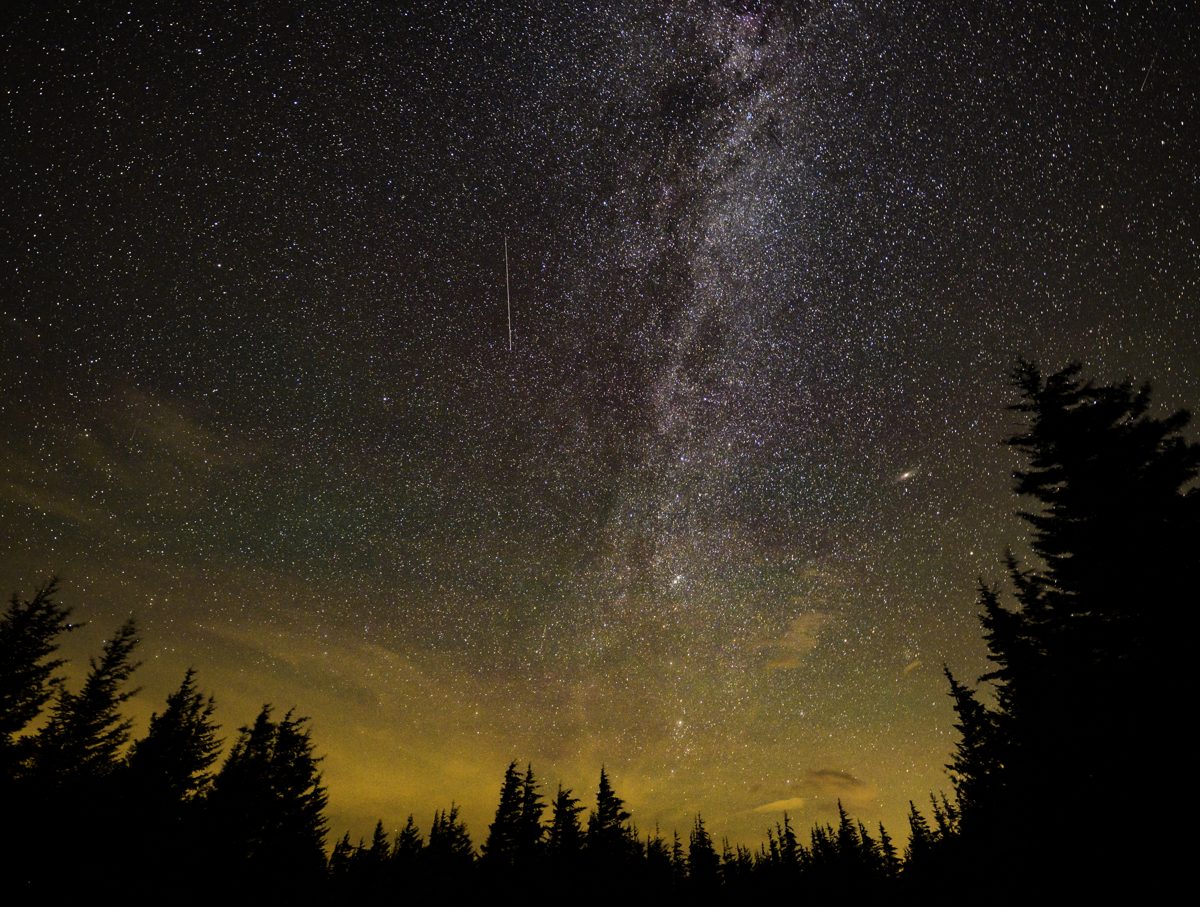
A meteor shower's radiant describes an apparent direction of origin. If you trace suitable meteor paths backward, they seem to converge toward a region of the sky. The shower is commonly named for the constellation containing that region, but the constellation is not producing the meteors. The light occurs in Earth's atmosphere when incoming material interacts with it. Keeping the distinction clear helps you use a sky chart without mistaking the radiant for a tiny object that must remain at the center of your attention throughout the session.
The American Meteor Society advises observing a broad, dark part of the sky rather than staring directly at the radiant. Meteors close to that apparent origin tend to have short-looking paths, while those farther away can cross a larger portion of your view. You are therefore choosing a useful viewing area, not aiming at one star as though it were a telescope target. The radiant still matters when deciding whether a shower is favorably placed, but finding it and continuously watching it are different tasks. A map supplies orientation, not instructions to ignore the surrounding sky.
Choose your actual viewing area
Choose the direction from your actual seated or reclining position. Look for nearby lamps, bright windows, rooflines and tree canopies that could interrupt the view. A place may have a low horizon in one direction and an intrusive light in another. You do not need to watch a geometrically perfect patch to benefit from comparing those options. Prefer the part that combines a comfortable position with less glare and fewer obstacles. If several directions appear suitable, settle on one that you can watch without continuously shifting your posture or reorganizing the setup.
An obstruction removes a piece of the sky you might otherwise notice. Moving a short distance can sometimes change that view substantially, even if the general sky brightness remains similar. Check before the important part of the session rather than discovering the problem after becoming settled. Do not turn this into a claim that a particular blocked fraction produces an identical percentage reduction in meteors; the display, your attention and the geometry are not that simple. The practical conclusion is enough: an avoidable roof or tree in the viewing area is worth addressing.
Separate glare from skyglow
Keep direct light and general skyglow conceptually separate. A nearby lamp can glare into your eyes even where the wider sky is fairly dark. A city can brighten a broad horizon without any single lamp shining at you. Changing the direction of your chair may help the first problem more than the second. The highest-ranked site-selection tip deals with the wider environment. Here the purpose is to use the site intelligently once you have arrived. Check how vehicles or occupied buildings might change the immediate lighting without assuming that every light will stay fixed all night.
This tip ranks seventh because it helps translate a good general location into a useful actual view. Learn the radiant's role, then give yourself permission to look away from it. You should finish with a clear understanding of which part of the sky you watched and why it was chosen. If conditions change, reassess deliberately rather than scanning in frustration. A broad, steady view supported by a comfortable position is a better starting point than treating every brief streak as a target that needs to be pursued after the fact.
Source: American Meteor Society.
Photo: Perseid Meteor Shower NHQ202108100009 · NASA/Bill Ingalls · NASA media guidelines. U.S. government work; resized and recompressed.