
Allow time to settle into darkness before judging a meteor display. NASA's Perseid advice recommends roughly twenty to thirty minutes for your eyes to adjust. That is a practical planning interval, not an appointment at which a precise number of faint objects suddenly becomes visible. The wider lesson is that stepping straight out of a bright environment and looking up briefly is a different experience from spending time in a genuinely dark setting. Give the observing conditions an opportunity to work before deciding that the night contains little worth watching.
Build this interval into the schedule instead of treating it as wasted time. Arrive, arrange the chair, finish necessary messages and identify the broad viewing direction before the part of the session you most want to use. If the shower's useful window is limited, do those tasks earlier rather than spending the whole window organizing equipment. You can begin looking at the sky while settling in; the point is not to wait with your eyes closed. It is to recognize that a first impression immediately after bright surroundings may not describe the rest of the session.
Reduce bright interruptions
Bright screens and torches work against the dark environment you selected. Prepare essential information in advance so that checking a time or direction does not become a repeated excursion through several brightly lit pages. If you need illumination, use only what the task requires and avoid directing it toward other observers. NASA's site-finding guidance recommends minimizing bright devices and using very dim light. A light's color alone is not a reason to make it unnecessarily bright or intrusive. The practical aim is fewer interruptions, not collecting accessories that introduce more controls to operate.
Decide which phone functions are genuinely needed outside. You may want access to transport information, a saved map or an observing note. Those can be useful without keeping the screen active continuously. Complete optional conversations before the session where possible, and arrange a simple way to record an observation if counting matters to you. The goal is not a rule that forbids all technology. It is a setup in which technology supports the observing task instead of repeatedly replacing it. Make that choice deliberately rather than discovering the distraction after an hour has disappeared.
Know what adaptation cannot change
Be realistic about what this preparation can change. Dark adaptation does not remove clouds, switch off city skyglow or move the Moon below the horizon. It is one element within a larger plan. If the entire sky is bright or covered, waiting longer does not guarantee an impressive display. Conversely, a modest shower under good conditions can still offer an enjoyable session. Evaluate the environment and your observing habits together, rather than selecting a single explanation for every disappointing result. Notes about lights and interruptions help make that evaluation more useful afterward.
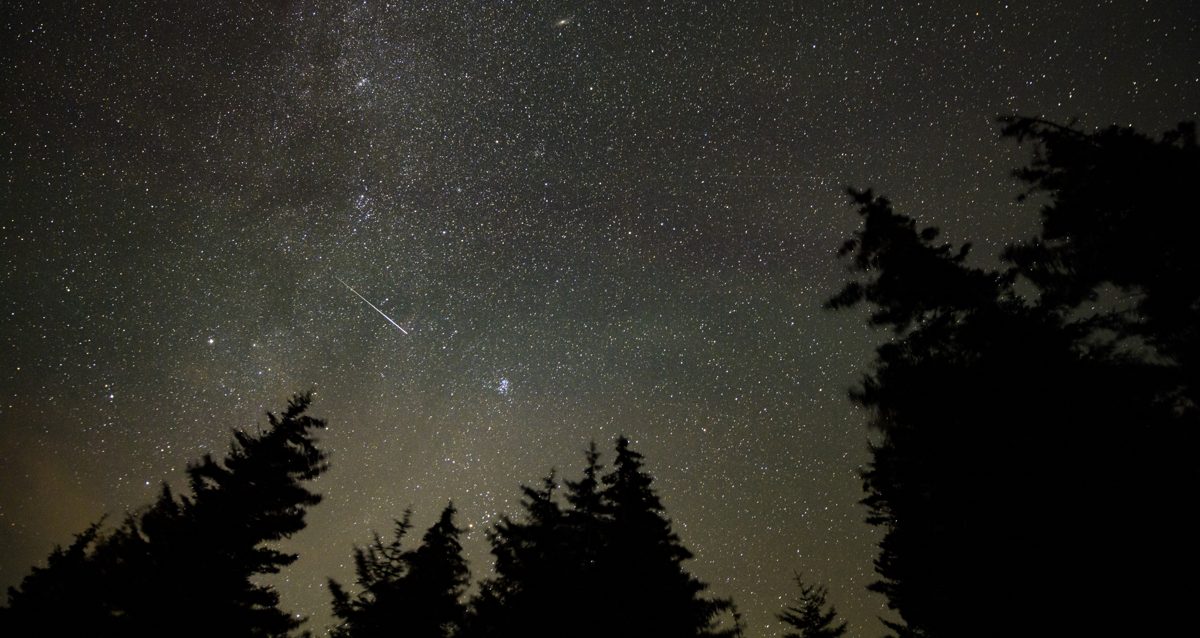
This tip ranks sixth because it concerns how you use the conditions once a site and time have been chosen. The archive photographs accompanying it are long exposures, so they cannot establish exactly what dark-adapted eyes will see. Treat them as illustrations of real events, not a visual target that must be matched. A useful outcome is a calmer session with less screen checking and a clearer sense of the surrounding sky. When you leave, ask which avoidable source of brightness interrupted the experience and how the next outing could be arranged more simply.
Source: NASA.
Photo: Perseid Meteor Shower NHQ202108110003 · NASA/Bill Ingalls · NASA media guidelines. U.S. government work; resized and recompressed.