
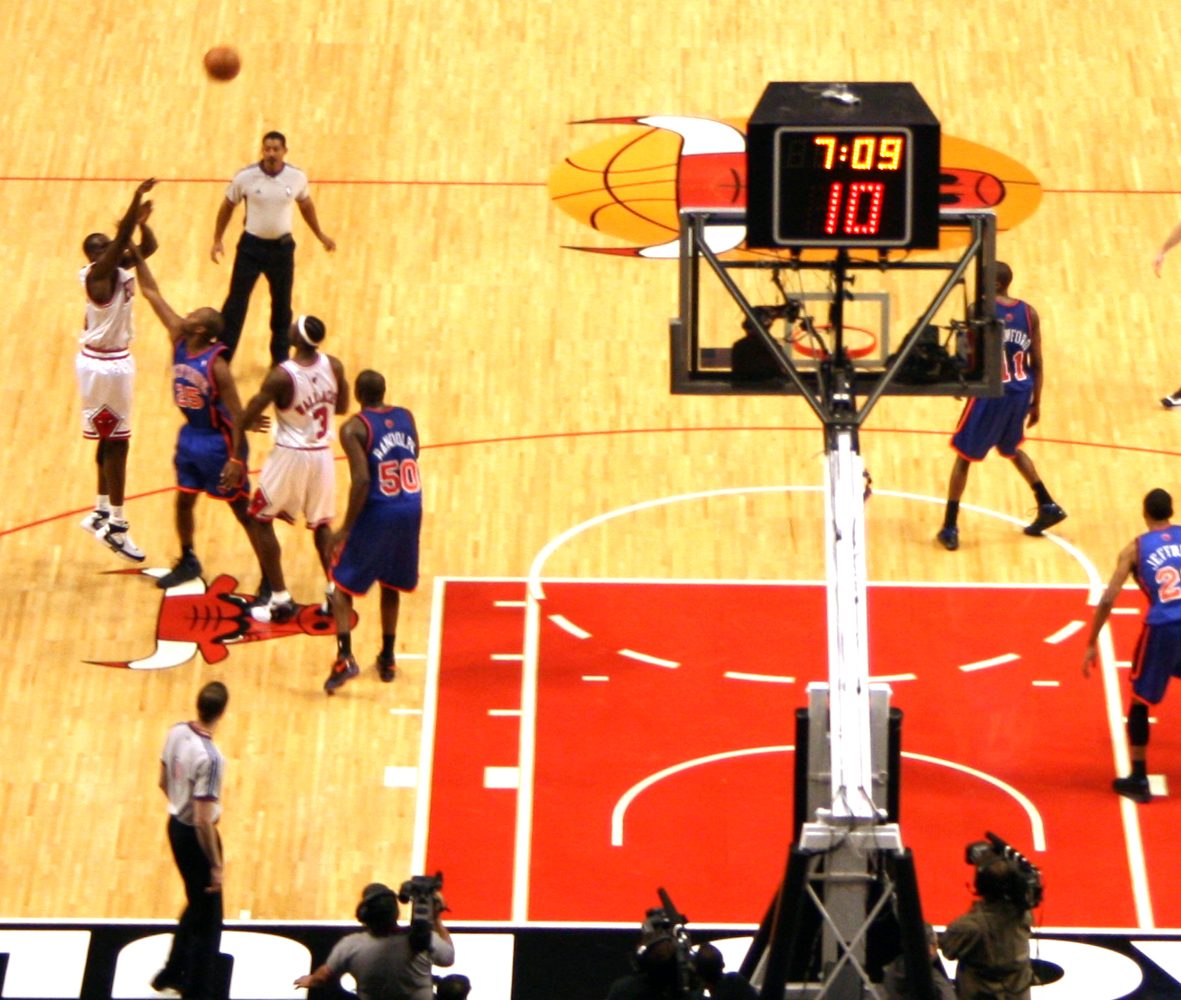
The shot clock takes first place because it explains the rhythm of almost every organized NBA possession. It limits the time a team can use before producing a qualifying shot attempt. Under Rule 7, a new possession ordinarily begins with twenty-four seconds, with specific fourteen-second resets and other treatments for different situations. The useful idea is a deadline that belongs to the possession, distinct from the remaining period. Once you watch that deadline, a hurried pass, a late difficult jumper or a deliberate early attack becomes a more understandable response to a shared constraint.
A qualifying attempt requires more than throwing the ball upward before the buzzer. The ball must leave the shooter's hand in time and then contact the basket ring, or go through for a valid score. An attempt that only strikes the backboard does not provide an ordinary fresh possession clock. Consider a hypothetical desperate shot released with a fraction of a second left that misses the rim. Catching the rebound does not erase the expired deadline. This is why a player can secure the ball after an apparent shot and still hear a violation rather than begin another unrestricted attack.
Reading the sequence
An offensive rebound is an especially useful example. After a qualifying unsuccessful attempt contacts the ring, the attacking team may recover the ball and receive the fourteen-second treatment described by the rule. A defensive rebound that establishes new possession ordinarily produces twenty-four. Both involve somebody catching a missed shot, but they are different possession events. Watching the rebounding player's team is therefore essential. A broadcast can move rapidly from the miss to another attempt, and understanding the shorter renewed deadline helps explain why the second attack develops differently from a completely new trip up the court.
A defensive deflection also does not automatically create a new possession. If a defender bats the ball out without gaining control, the attacking team can retain only its remaining time under the applicable provision. Other defensive violations or fouls have specified reset treatments, including situations using the greater of the time remaining and fourteen seconds. The rule's details prevent a single slogan from covering every stoppage. The beginner's useful habit is to check what caused the interruption before assuming a full reset. A team keeping the ball has not necessarily received a fresh twenty-four seconds.
What to watch next
Now place the possession inside the end of a period. If less game time remains than a normal new shot-clock period, the game clock can become the effective deadline, subject to the rule's particular reset situations. Imagine one team beginning a possession late in the quarter while its opponent hopes to get the ball back. The offense's pace affects whether another opportunity is likely to remain. Taking a quick attempt may leave time for the other side; holding longer may reduce that opportunity but can also limit the quality of the eventual shot. Those tradeoffs explain strategy without requiring an invented win-probability number.
Our winner is therefore a viewing tool rather than the most dramatic whistle. Watch one possession from control to resolution, noting the initial time, any deflection, the shot's contact with the rim and who gains control afterward. Then compare the next clock with the event you saw. This small exercise brings passing, rebounding, pressure and late-game decisions into a single framework. Scoring remains a credible first lesson and fouls can dominate a close finish, but possession timing gives the broadest continuing payoff under our criteria. Which rule would you teach first to someone watching their first full NBA game?
Source: NBA Rule 7 · 2026–27 official rulebook (PDF).
Photo: Gavin J. Dow (Gavindow); source crop/color correction by HITNOM and Adeletron 3030 · CC BY 3.0. NBA shot and game clocks, Chicago, 14 December 2007; archive context, not a ruling on this play. Optimized local image; resized/recompressed, with any existing source crop retained. No new crop.
