
The two three-second rules share a number but serve different purposes. Offensive three seconds limits an attacker remaining in the lane while the relevant team-control and frontcourt conditions apply. Defensive three seconds addresses a defender in the lane who is not satisfying the guarding requirements. NBA Rule 10 explains both, including suspensions of the count and allowances. They rank eighth because they make spacing around the basket easier to understand. They do not mean that every player must leave the paint whenever a spectator can count to three while watching television.
For the offensive rule, imagine a center waiting close to the basket while teammates pass around the perimeter. The important questions include whether the offense controls the ball in the frontcourt and whether the player remains in the restricted lane area. A shot, a loss of control or an imminent exit can change how the sequence should be assessed. The viewer should therefore track the whole action rather than start an independent count at the beginning of a replay clip. Edited highlights may omit the moment that makes the apparent long stay understandable.
Reading the sequence
For the defensive rule, imagine a help defender stationed between the ball and the rim while an opponent stands far away. The NBA requires the defender to guard actively under the rule's conditions, with specific treatment for the player guarding the ball. The full text defines active guarding in terms of position and proximity. This is not a general ban on zone defense or double-teaming. A defender can move through the lane, guard an opponent and help a teammate, but cannot assume that simply being somewhere near the basket makes every extended stay permissible.
These restrictions create movement that is easy to miss if you only watch the ball. A big defender may step completely outside the lane before returning to help. An attacker may clear the paint instead of remaining underneath the rim and calling for a pass. Those movements can serve several tactical purposes; the rules provide one possible explanation rather than proof of intent. Watch the off-ball player for a full possession and notice how their location changes with the ballhandler. Suddenly the empty space near the hoop looks like something teams maintain, not an accidental gap.
What to watch next
The penalties also distinguish the rules. An offensive three-second violation costs possession. A defensive three-second violation brings the technical-foul procedure described by Rule 10, with the offense retaining possession and the specified clock treatment. A successful field goal during the defensive violation has its own treatment in the rule. Do not translate every whistle into the same assumed result. Listening to the announced violation can explain why one team is inbounding while the other situation involves a free throw, even though a commentator used the same shorthand number for both events.
A practical exercise is to choose one interior player and ignore the scoreboard for a possession. Observe where the player is, whether they are guarding someone, and whether the offense still has control. Then replay the sequence without trying to convict anyone from a cropped angle. This topic could rank higher for someone used to international basketball, because the NBA's defensive restriction can change familiar expectations. We put it eighth for a general beginner: it adds a valuable layer to spacing, but is easier to learn after possession, the shot clock and ordinary contact have become recognizable.
Source: NBA Rule 10 · 2026–27 official rulebook (PDF).
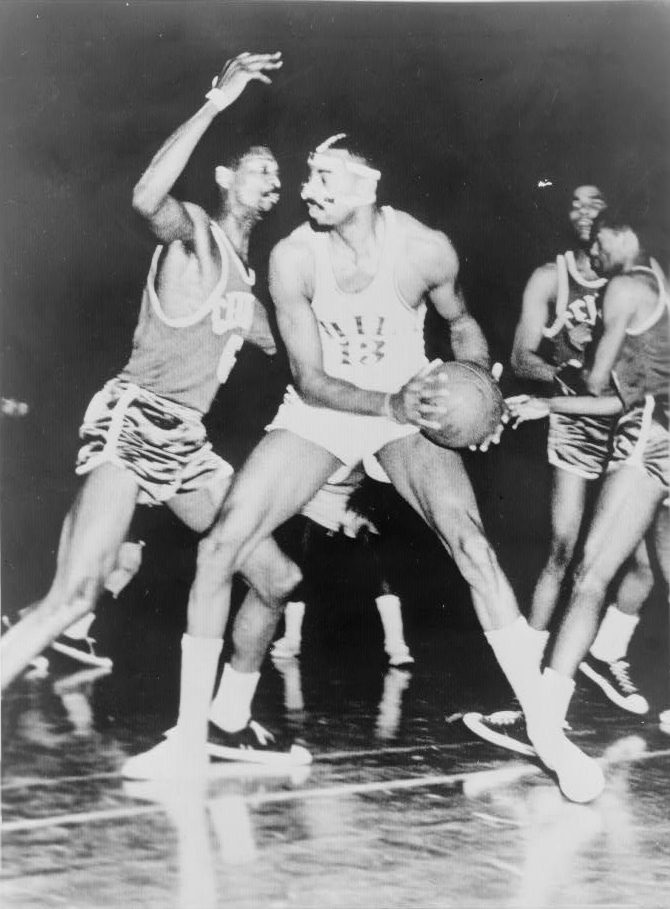
Photo: NYWT & Sun staff · Library of Congress, Prints & Photographs Division, NYWT&S Collection, cph.3c15430 · Public domain. Chamberlain and Russell, 1966; historical interior-play context, not evidence of modern three-second rules. Optimized local image; resized/recompressed, with any existing source crop retained. No new crop.
