
Traveling ranks fourth because it is one of basketball's most recognizable complaints and one of its least useful judgments when made from memory alone. In the NBA, assessing a moving player's steps requires identifying the gather and subsequent foot contacts. The published definitions describe when control is established, and Rule 10 explains permitted steps and pivoting. Counting every visible footfall from the beginning of a dribble can produce the wrong answer. Equally, invoking the word gather does not grant unlimited movement after a player has clearly controlled the ball.
Take a hypothetical drive in slow motion. Before control is gathered, the player is still dribbling. After the relevant control point, the permitted progression must be assessed using the rule's step sequence. A good replay therefore needs the hands and the feet, not only one or the other. If the ball is hidden behind the body, you may be able to count contacts with the floor without knowing where the count should begin. That uncertainty is a reason to reserve judgment rather than pretend the camera has shown something it has not.
Reading the sequence
A stationary pivot is a different situation that beginners often mix with a running finish. After a player has legally established a pivot foot, beginning a dribble requires releasing the ball before lifting that foot. For a pass or shot, lifting the pivot can be permissible if the ball is released before the foot returns to the floor. These are distinct sequences with distinct conditions. A viewer who assumes that lifting the pivot is always forbidden will misunderstand ordinary legal shooting and passing movements; a viewer who ignores the return to the floor will miss the other half of the restriction.
Dribble control adds another layer. Stopping a dribble and starting again is generally prohibited unless a relevant exception applies. Carrying involves the hand's relationship to the ball and the prohibited pause or movement described by the rule. A change of direction can be visually deceptive without being illegal, and a smooth-looking action can still violate a control restriction. Watch for what happened to the ball rather than using elegance as proof. This is also why an old playground slogan may not describe every detail of an NBA sequence under the league's current wording.
What to watch next
The tactical consequence of ending a dribble is immediate. Imagine a ballhandler who picks the ball up near the sideline under pressure. With no ordinary option to resume dribbling, passing, pivoting and shooting become the available ways to resolve the situation legally. Defenders may try to limit those options, while teammates move to provide a passing angle. Understanding that constraint makes a seemingly timid pass more intelligible. It may be a response to the legal choices left after control has been established, rather than an inexplicable refusal to continue attacking an apparent gap.
To practice, select a clear league video example and identify the control point before counting steps. Then separately ask whether the player is starting a dribble, continuing a moving finish or using a stationary pivot. Do not mix those questions into one vague impression of too much movement. We rank traveling below the foul system because contact affects a broader range of interactions, but above backcourt rules because footwork appears throughout ordinary individual play. A fan fascinated by skill could reverse that order. The useful disagreement concerns what helps a beginner learn, not whether still photos can settle every disputed finish.
Source: NBA Rule 4 · NBA Rule 10 · 2026–27 official rulebook (PDF).
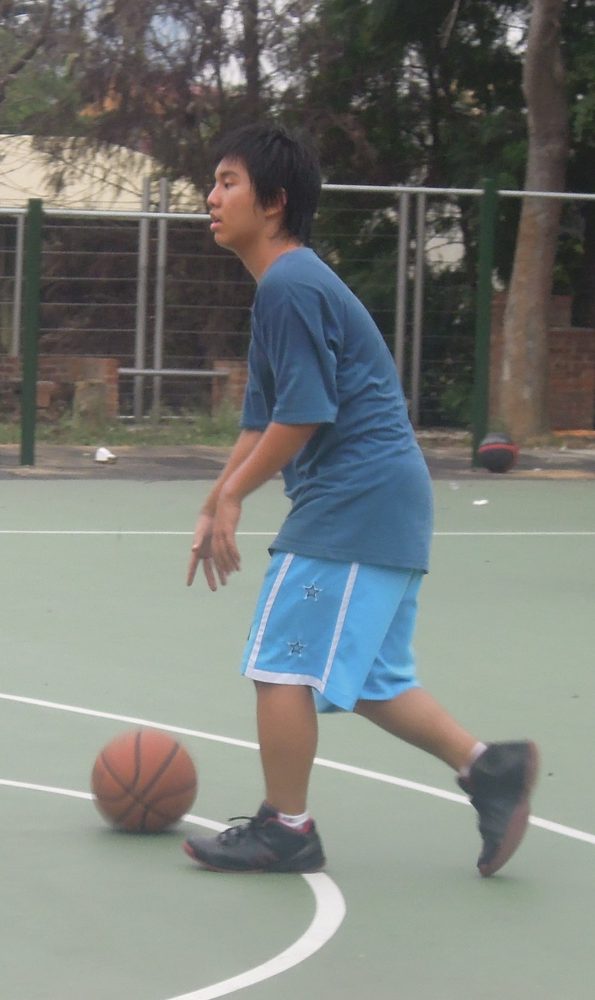
Photo: Wenhaolee; edited by VolodyA! V Anarhist · CC BY-SA 3.0. Outdoor dribbling photograph, Commons derivative dated 29 October 2011; not an NBA game or proof of traveling. Optimized local image; resized/recompressed, with any existing source crop retained. No new crop.
