
Boundary rules rank sixth because they decide who gets the next opportunity to attack. In NBA basketball the lines themselves are out of bounds. A player touching a boundary is not safely in simply because most of their body remains above the court. Ball status also depends on what it touches, and Rule 8 describes out-of-bounds situations and the subsequent throw-in. Begin with that physical boundary rather than the crowd's reaction. A spectacular save can still end in a turnover if the player had already touched an out-of-bounds surface before making contact with the ball.
Consider an invented chase toward the sideline. A player jumps from inbounds, catches a loose ball in the air and passes it to a teammate before landing outside. Compare that with a player who steps on the sideline and then touches the same loose ball. Those sequences are not equivalent. The order of floor contact and ball contact matters. A television view from above may show the ball clearly while hiding the shoe against the painted line, which is why another camera angle can be more informative than repeatedly slowing the original shot.
Reading the sequence
Last touch is another question, separate from whether the ball crossed the boundary. A defender can knock the ball away without gaining possession, and the original attacking team may receive a throw-in if the defender touched it last. That does not automatically give the offense a fresh shot clock. A novice who treats every stoppage as a reset may wonder why an inbound pass is followed by an immediate desperate attempt. Reading possession and remaining time together explains the pressure: the offense has kept the ball, but it has not necessarily received additional time to use it.
A throw-in is also a regulated action, not an informal pass from the crowd. The thrower generally has five seconds to release the ball and must follow the restrictions of the designated spot. After a made field goal, different endline privileges apply. These distinctions matter when a team runs along the baseline after conceding a basket but seems confined beside the sideline after another stoppage. The players are not necessarily being granted inconsistent freedom. The reason the throw-in occurred can determine what the person returning the ball to play is allowed to do.
What to watch next
Watch the teammates before the thrower. Defenders can deny the most obvious receiver, forcing cutters to change routes and making the release deadline important. In a hypothetical late possession, an offense might use a screen away from the ball to create a safe first pass rather than attempt a difficult direct pass under the rim. That is one possible tactical response, not a claim that every inbound play follows the same design. The rule creates a constraint; teams choose different ways to solve it depending on personnel, time and the desired opportunity.
For a small viewing exercise, identify three things after each boundary whistle: which team receives the ball, where the throw-in occurs, and how much possession time remains. Add the reason for any unusual endline movement before assuming a violation. Some fans would rank boundaries above traveling because a single late-game touch can decide an outcome. We keep them sixth because they explain a restart more directly than the continuous action. Still, this is an especially useful bridge from simply following the ball to understanding how a team must organize the next possession under specific spatial and timing restrictions.
Source: NBA Rule 8 · NBA Rule 10 · 2026–27 official rulebook (PDF).
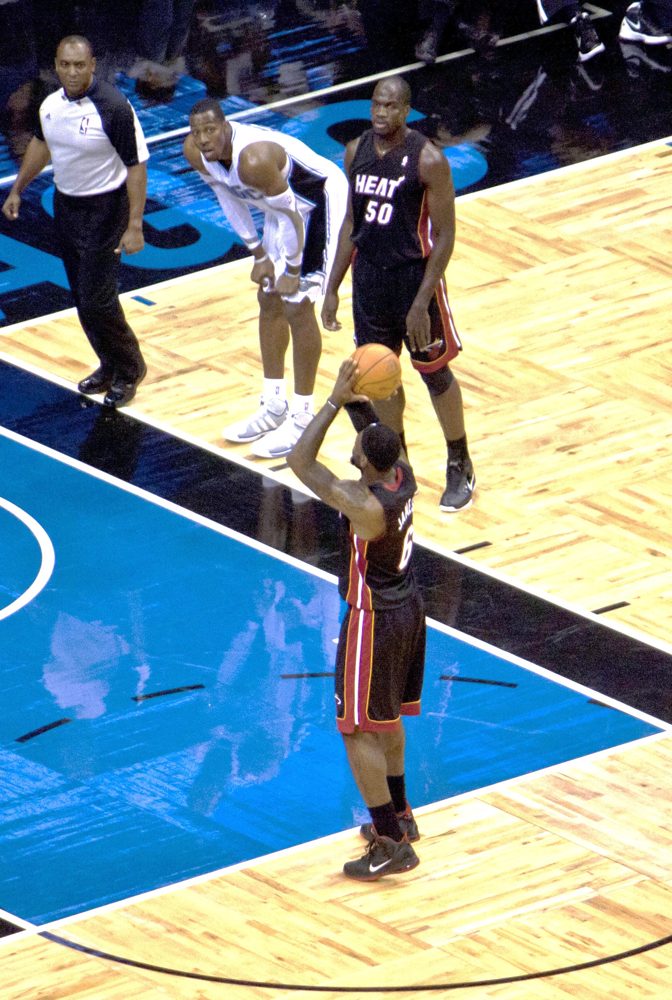
Photo: RMTip21 · CC BY-SA 2.0. LeBron James at a preseason free throw, 21 December 2011; archive context, not proof of a foul. Optimized local image; resized/recompressed, with any existing source crop retained. No new crop.
