
Fouls, free throws and the team penalty rank third because they connect physical contact to consequences on the scoreboard. Basketball permits close competition for space, but not every form of contact. NBA Rule 12 describes personal fouls, offensive fouls, screening contact and special categories. A whistle does not simply mean that two bodies touched. The nature of the contact, their positions and the action underway matter. For a new viewer, identifying the category is more useful than assuming that the player who fell must be the person entitled to free throws.
Start with an ordinary shooting example. If illegal defensive contact occurs during an unsuccessful two-point attempt, the standard result is two free throws; an unsuccessful three-point attempt brings three. If the basket is made with the qualifying defensive foul, the score can count with an additional free throw. These basic outcomes help explain the familiar phrase and-one. They are not a promise that every whistle near a shot produces that result. Whether the player was in the act of shooting and how the foul is classified can change what officials administer after the play.
Reading the sequence
Next consider a common defensive foul away from a shooting attempt. The offense may inbound rather than shoot free throws until the team-penalty conditions apply. In regulation, common team fouls beyond the ordinary allowance of four lead to the specified penalty; overtime uses a different allowance, and the final two minutes have an additional provision. The full wording matters. A broadcast's bonus indicator is a useful clue, but a beginner should not turn it into the claim that every later foul of every category yields the same two-shot result regardless of its circumstances.
Individual and team totals answer different questions. A player's foul count concerns that player's participation limits, while a team's count helps determine the penalty situation. An ordinary offensive foul is not administered like a common defensive foul that puts the opponent in the bonus. Technicals and flagrant fouls have their own conditions and penalties. Separating those categories helps explain why the officials might award a free throw and possession in one sequence, a throw-in in another, and no valid basket after an offensive foul. The word foul is the beginning of the explanation, not its completion.
What to watch next
The viewing payoff is tactical. Imagine a defender facing a drive when the team penalty already applies. Reaching carelessly can have a different consequence from forcing the attacker to make a difficult legal shot. Meanwhile, an attacker who knows contact may produce free throws can choose to drive rather than settle for another option. Those are possible decisions under the rule framework, not evidence of a player's private intention or a guarantee of success. You can understand the incentive without assuming that every drive seeks a whistle or every defender is deliberately avoiding contact.
Try sorting a stoppage into three questions: was the foul offensive or defensive, was there a qualifying shooting action, and does a team-penalty or special category apply? Then listen to the official outcome. This sequence usually teaches more than arguing from the loudest reaction. Fouls have a strong claim to first place because they affect strategy and generate difficult judgments. We keep them third because their branches are easier to learn once scoring and possession timing are familiar. The goal is a more informed question, not instant certainty about every collision shown from a single broadcast angle.
Source: NBA Rule 12 · 2026–27 official rulebook (PDF).
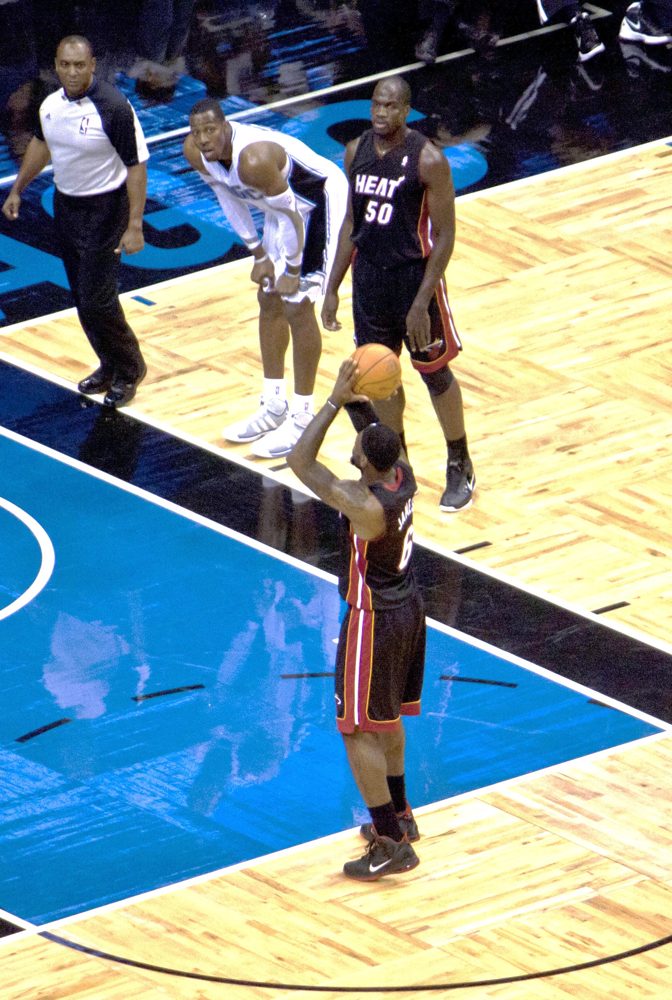
Photo: RMTip21 · CC BY-SA 2.0. LeBron James at a preseason free throw, 21 December 2011; archive context, not proof of a foul. Optimized local image; resized/recompressed, with any existing source crop retained. No new crop.
