
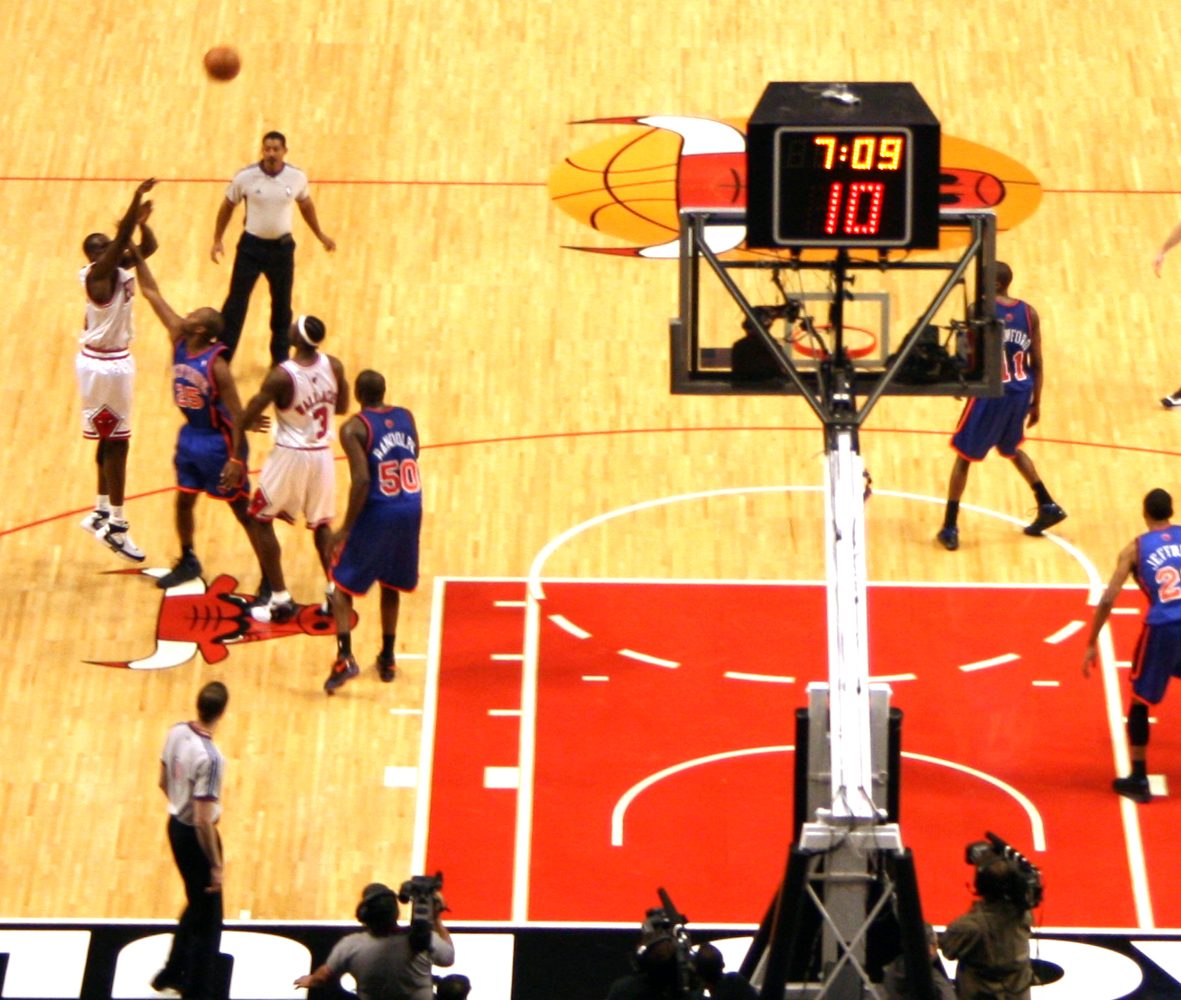
Scoring and game time rank second, and they are the strongest alternative to our winner for a complete newcomer. A successful free throw is worth one point. An ordinary successful field goal counts two, while a qualifying attempt from outside the three-point line counts three. NBA Rule 5 sets out these scoring distinctions alongside timing. The numbers are simple; the viewing implications are richer. A team chasing a small deficit may have several plausible options, and the value of each attempt depends on what it can realistically create before the available time expires.
Watch the shooter's feet, not the apparent length of the attempt. A foot on the three-point line places the shot in two-point territory. A player can release a legal three-pointer and subsequently land inside the line; the landing does not retroactively turn it into two. In an invented replay, the shooter's torso may be far beyond the arc while a toe touches the paint. The official scoring question concerns the relevant floor contact before release, not how deep the shot looked from the main broadcast camera or how spectacular the follow-through appears afterward.
Reading the sequence
NBA regulation consists of four twelve-minute periods, and overtime periods last five minutes. The displayed game clock is playing time rather than a prediction of how many real-world minutes remain before the broadcast ends. Whistles, free throws, timeouts and reviews can interrupt the action. A viewer planning around the clock should therefore distinguish remaining basketball time from wall-clock time. The final minute of a close game can include several meaningful possessions and interruptions, but no fixed multiplier reliably tells you how long it will take to watch the finish.
The game clock and shot clock answer different questions. One measures the remaining period; the other limits an attacking possession. Imagine a team trailing by two with enough game time for more than one possession. It might pursue a quick two, seek a three, or wait for a better opening, with different risks. This article does not prescribe a universal best choice. The example shows why the same shot can be sensible in one clock situation and questionable in another. Reading the score alone leaves out the information that gives the decision its context.
What to watch next
Late-period scoring also depends on release timing. A ball can be in flight when the period expires and still produce a valid basket if the attempt meets the rule's conditions. Contact, offensive touches and other events can change the analysis, so the complete sequence matters. A replay that freezes the ball already away from the hand is helpful only if it also establishes when that happened relative to the official clock. The crowd's celebration and the arena horn are visible parts of the moment, but the relevant rule is more precise than whichever reaction reaches you first.
Practice by pausing before a late possession and describing the situation in one sentence: the deficit, remaining game time, remaining possession time and available scoring options. Then watch how the team responds. This turns a finish into a series of choices rather than a single dramatic shot. We place scoring second only because it becomes a familiar foundation quite quickly, while the shot clock keeps explaining new decisions throughout the game. If you are introducing basketball to someone with no prior knowledge, teaching this page first is entirely reasonable and does not undermine the criteria behind our countdown.
Source: NBA Rule 5 · 2026–27 official rulebook (PDF).
Photo: Gavin J. Dow (Gavindow); source crop/color correction by HITNOM and Adeletron 3030 · CC BY 3.0. NBA shot and game clocks, Chicago, 14 December 2007; archive context, not a ruling on this play. Optimized local image; resized/recompressed, with any existing source crop retained. No new crop.
