
The eight-second rule and the backcourt restriction rank fifth as a pair because they explain why advancing the ball is a meaningful task. The first limits how long a team can remain in its backcourt during continuous possession. The second generally prevents a team in control from being the first to touch a ball it caused to return from frontcourt to backcourt. NBA Rules 4 and 10 define the relevant locations and exceptions. The midcourt line is not merely decoration, but neither is every pass that looks backward automatically a violation.
Begin with the dribbler's status. NBA definitions consider the ball and both feet when establishing frontcourt status during a dribble. A player leaning across the line does not necessarily establish the same position as a player whose feet and ball have all moved into the frontcourt. This matters when a defender pressures the advance. An overhead broadcast may make the crossing look obvious before the relevant elements are across. Follow the ball and shoes together instead of deciding from the direction the player's torso faces or the place their head appears on screen.
Reading the sequence
Now imagine a team that has clearly established control in the frontcourt. A careless pass returns toward its own backcourt and a teammate retrieves it first. Compare that with a defender deflecting the pass backward. The touch sequence changes the rule question. Likewise, a loose rebound or a jump-ball situation can involve different control conditions from an ordinary completed possession. These are reasons to resist the simple instruction that the ball can never go back across halfway. The restriction depends on team control and responsibility for the return, with specific exceptions in the full rulebook.
Eight seconds creates pressure before the main half-court offense even begins. An invented defensive press might force a ballhandler to turn away from the sideline, use a retreat dribble and pass to a trailing teammate. Those actions can be sensible attempts to preserve the ball, but the offense must still manage the advancement deadline. A defensive touch that sends the ball out does not mean every clock automatically starts over. Check the relevant reset rules and the announced remaining time rather than treating a whistle as a universal new beginning for the offense.
What to watch next
Tactically, a team can win something without making a steal. If its pressure forces the offense to spend time merely establishing a safe frontcourt position, the eventual attack may begin with less possession time. That is a qualitative way to read the sequence, not an invented efficiency measurement. The attacking team may counter with an early pass, a different receiver or spacing that avoids trapping a dribbler against the boundary. A turnover is the visible extreme; making the next action more hurried can be part of the same contest over time and space.
Our exercise is to trace one advance with four questions: who has control, where are the ball and feet, what caused any return across the line, and what time remains? Answering all four is more useful than shouting backcourt when a player runs toward their own basket. Someone learning from another sport might put this topic lower because it seems technical. We place it fifth because it introduces the connection between territory and possession without requiring advanced tactics. It makes defensive pressure legible and prepares the reader for the shot-clock decisions that determine our number-one choice.
Source: NBA Rule 4 · NBA Rule 10 · 2026–27 official rulebook (PDF).
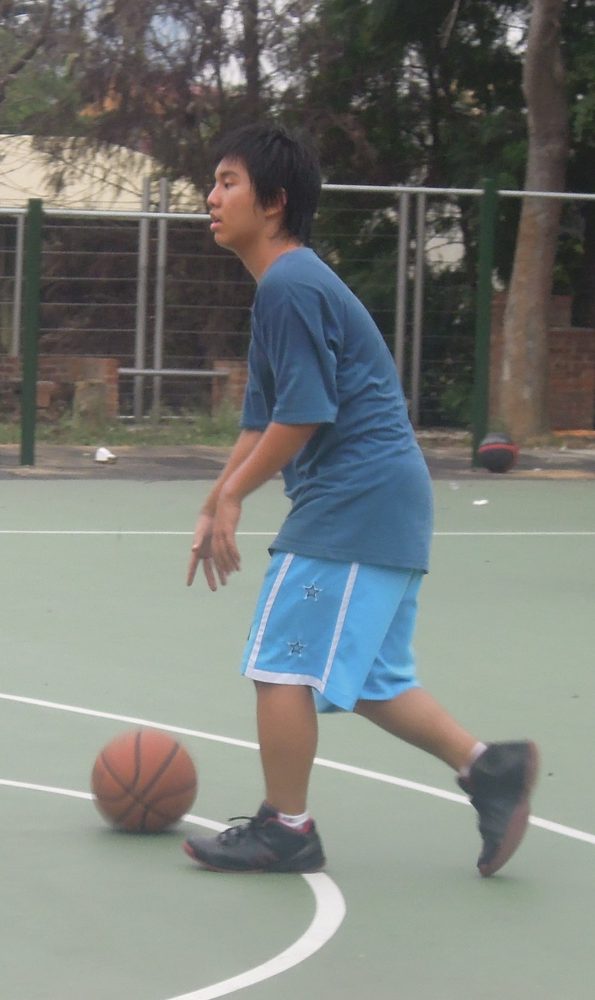
Photo: Wenhaolee; edited by VolodyA! V Anarhist · CC BY-SA 3.0. Outdoor dribbling photograph, Commons derivative dated 29 October 2011; not an NBA game or proof of traveling. Optimized local image; resized/recompressed, with any existing source crop retained. No new crop.
