
Which operating system changed computing most: UNIX, Linux or Windows? The answer depends on whether we reward the original ideas, the freedom to adapt them or the ability to make them practical for an enormous software ecosystem. This ranking chooses historical influence, reviewed on 18 October 2026, rather than the best system to install today. UNIX takes first, Linux-based systems second and the Windows NT family third. The result is deliberately debatable. A reader who values collaborative development above the origin of a design tradition can reasonably reverse the top two, while a desktop-first reader has a strong case for Windows.
We use three criteria: durable technical ideas, the ecosystem a system enabled and its influence beyond its original hardware or audience. These are editorial judgments, not a benchmark score, security certification or current market-share table. A successful interface can matter alongside a less visible kernel design. Longevity matters when ideas continue to shape later systems, not simply because old software can still be started in an emulator. The list includes selected systems, families and major platform transitions. Each entry states its unit of comparison, so a family is not silently treated as one unchanged release or as the work of one person.
How influence is judged
The entries overlap historically, and that overlap is part of the subject. Android uses the Linux kernel but adds a distinct application platform and device ecosystem. Mac OS X combined an Apple desktop experience with a different underlying architecture from classic Macintosh software. Linux is Unix-like without being the original Bell Labs source tree. We therefore compare influential contributions, not ten mutually exclusive branches of a family tree. A lower position does not erase borrowed ideas, and a higher one does not award every descendant's achievement to an ancestor. The distinction makes the comparison more honest than pretending that each platform appeared independently.
Search demand supplies a present-day route into that history. US Google Trends Explore, past 90 days, all categories and Web Search, inspected on 18 October 2026, showed average relative indices of 69 for Linux, 70 for Windows 11 and 23 for macOS. The related query unix legacy on modern linux appeared at +2,000%. These are relative-interest measures, not monthly search volumes, installed-user counts or votes for our winner. Unrelated travel and cooking queries, and unverified version or feature queries, were not used as factual evidence. Historical claims below come from original developers, manufacturers, project documentation and museum research.
Sources and competing cases
A kernel is only part of a complete working environment. Applications also depend on libraries, interfaces, drivers, distribution choices and the conventions people learn. That is why the ranking does not reduce operating-system history to a list of kernels or screenshots. When reading each entry, ask what problem became easier for developers or users, what compromises remained and how the achievement travelled. Compatibility, usability and permission to modify are different qualities. A system can excel at one while limiting another, and the disagreement becomes useful when the criterion is named rather than hidden behind the word greatest.
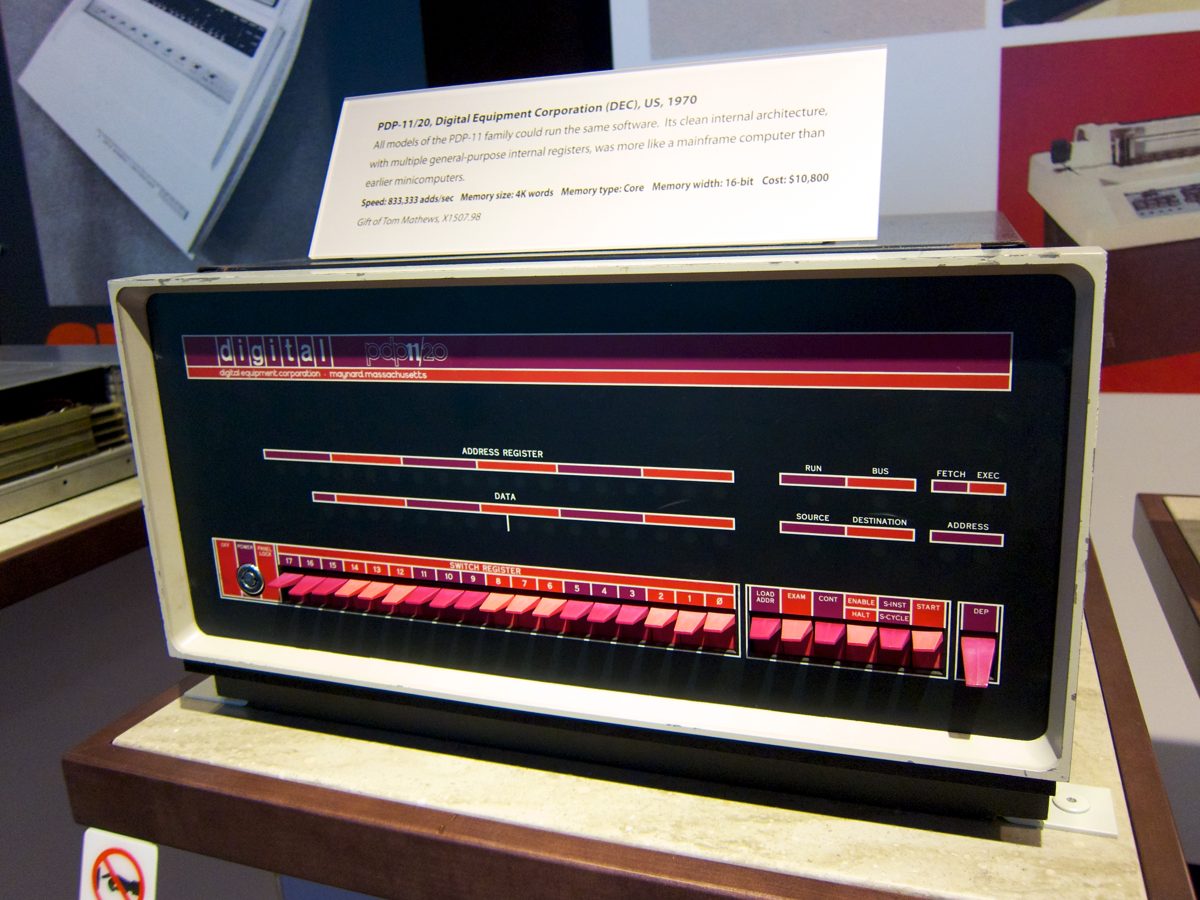
The archive photographs illustrate hardware and its era; they are not evidence of which software is installed or measurements of performance. Our retro-console ranking concerns game hardware and libraries, a different contest from this software history. Important omissions, including BSD, AmigaOS and other influential systems, underline that ten places cannot represent every tradition. The shortlist is an argument with boundaries, not a complete textbook. Follow the countdown from early microcomputer portability to the leading competing cases, then decide which influence deserves most weight. Would you reward the framework that others inherited, the community that made adaptation practical or the platform that preserved users' applications?
Source: www.unix.org · www.kernel.org. · Google Trends comparison
Photo: DEC PDP-11 20 computer at the Computer History Museum.jpg · Don DeBold · CC BY 2.0. Hardware archive illustration; no installed operating system or benchmark is authenticated. Resized and recompressed without cropping; transparent areas flattened to white where present. Original image license retained.
