
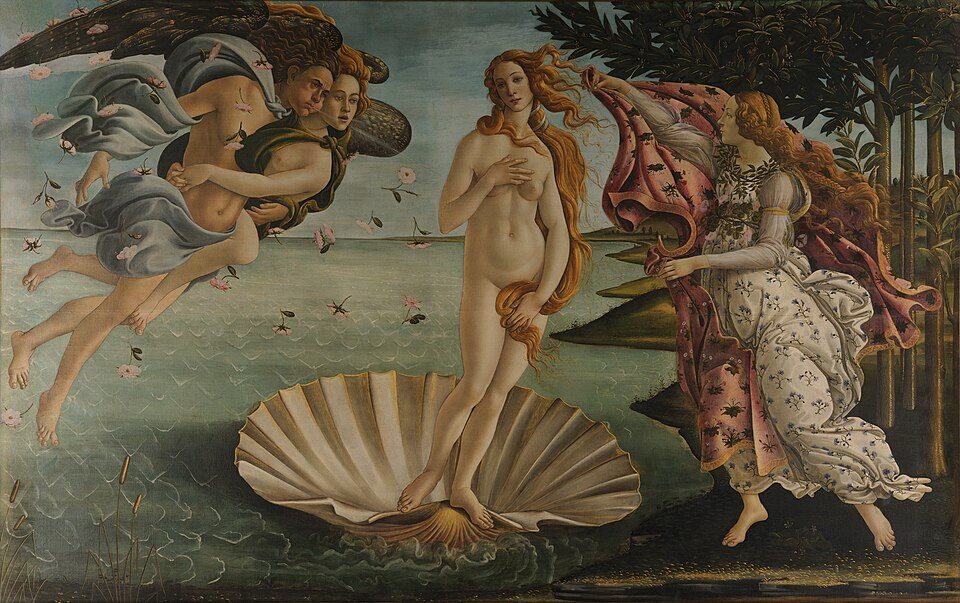
Florence's Uffizi earns third place and the strongest specialist claim to the top position. The museum's records identify Botticelli's Birth of Venus, dated around 1485, as tempera on canvas, while Primavera is painted on panel. Those familiar works are useful anchors for considering Renaissance painting without treating the museum as a shrine to two reproductions. Our argument for the Uffizi rests on the relationship between a concentrated artistic field and its destination. A visitor can carry questions about figures, space and patronage into the surrounding city, while remembering that the collection itself reaches beyond a simple postcard image of Florence.
Begin with the difference between recognition and looking. You may know the outline of a famous composition well enough to name it instantly. Ask what that familiarity conceals: the relationships among gestures, the direction of movement or the way a figure meets the edge of the picture. A printed or digital reproduction can prepare a visit but may also make a work seem settled before you arrive. Give yourself time to notice something you did not already know. That detail need not be obscure. A new awareness of scale or spacing can be more valuable than memorizing another elaborate interpretation.
Familiar images, physical objects
The contrast between canvas and panel is an invitation to ask material questions carefully. It does not license a visitor to infer conservation history or technical causes from a quick glance. Instead, read the museum's object information and notice how a painting is both an image and a physical object. A mythological subject can prompt questions about audience, setting and the uses of classical stories. Keep uncertainties visible rather than replacing them with a confident claim about a patron's private motives. Renaissance art can be intellectually rich without requiring every detail to resolve into a single secret message that the visitor is expected to decode.
The strongest case for ranking the Uffizi first is coherence. A traveler primarily interested in Renaissance painting may prefer depth in that field to the Louvre's range or the Prado's different concentrations. Florence also makes it possible to think about how a museum collection relates to a city, though the present arrangement should not be confused with an untouched historical environment. Ask what changes when an object is brought into a museum and compared with works made for other settings. That question adds depth to the destination argument. The city gives context, but it does not automatically explain every object the collection contains.
The argument for first place
Why does it finish behind the Prado and Louvre here? Our criteria give extra weight to comparison across a wider field of painting and, at the summit, across several kinds of objects. That balance makes the Uffizi's concentration both its great attraction and the reason another traveler might choose differently. A specialist ranking could reverse the order without contradicting the facts. We also avoid treating the presence of a celebrated masterpiece as a guarantee of a satisfying visit. A thoughtful route through less familiar works may tell you more about the collection than spending the whole afternoon trying to reproduce a famous photograph.
Check current visitor information and collection records before choosing your anchors, including whether the works important to you are displayed. Do not rely on an old numbered room route or assume that a familiar painting will always be encountered in the same arrangement. After the visit, describe one connection between two works without using the word masterpiece. That simple exercise reveals whether you have formed an argument of your own. If Florence's Renaissance concentration would give your trip a clearer purpose than a broader survey, third place is a verdict you should challenge. Is depth in the art you most want to understand worth more than range?
Photo: Sandro Botticelli / Google Art Project · Public domain. Botticelli, The Birth of Venus, c. 1485; historical collection reproduction. Resized and recompressed without additional cropping; source license/status retained.
