
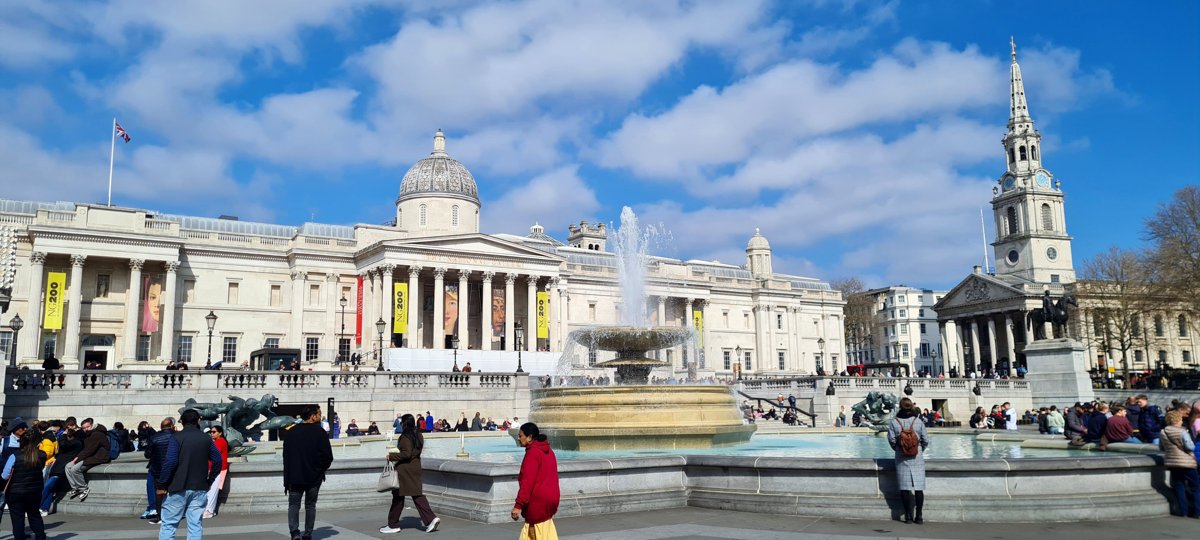
The National Gallery in London ranks seventh for a broad encounter with European painting. Its collection overview names van Eyck's Arnolfini Portrait, Turner's The Fighting Temeraire and Van Gogh's Sunflowers among its holdings. The important travel argument is not simply the presence of famous names. It is the possibility of comparing different solutions to pictorial problems within one institution. A portrait, a river scene and a flower arrangement can all direct attention in distinct ways. Treat the collection as a set of conversations rather than a sequence of increasingly valuable trophies, and the breadth becomes easier to use.
For a first route, choose a question that crosses periods. How do painters make a space feel inhabited? What does a reflection add to a scene? How can a sky influence the emotional weight of a small figure? A repeated question helps you avoid reading every room as a separate examination. You can compare what is visible without pretending that works made in different contexts carry identical meanings. Labels and the gallery's own collection records supply the necessary historical distinctions. Your observations then connect those contexts instead of flattening them into a universal claim about beauty or progress.
A question across centuries
The Arnolfini Portrait is a good reminder that careful description and confident interpretation are different activities. You can notice figures, surfaces and the relationship between foreground and background without claiming to settle every disputed detail of the scene. Give the painting time to become stranger than its familiar reproduction. A collection guide can explain what scholars know and where uncertainty remains. That is more useful than repeating a tidy internet story because it sounds memorable. When a picture raises questions you cannot answer, the visit is working: curiosity is a reasonable outcome, not a failure to understand the object immediately.
Our seventh place is particularly open to challenge by travelers who prioritize painting over sculpture or archaeological material. A broad painting collection can offer enough variety without the changes of medium that make a very large museum difficult to navigate intellectually. It also allows a visitor to return with a completely different question on a later trip. Someone interested in the relationship between landscape and history could construct a route unlike that of a visitor focused on faces. That flexibility is a substantive strength. It is not necessary to claim that every school is represented equally or that one visit could cover the whole collection.
Breadth and a competing verdict
Why do six museums finish above it? We give additional weight to a distinctive destination encounter: the Uffizi's concentrated Renaissance identity, the Prado's depth around major painters and the Louvre's range across media. Those are judgments about our chosen balance, not a verdict that London's pictures are less important. A reader who gives practical repeatability and a sustained painting survey more weight could reasonably put the National Gallery first. Our existing free London museums guide provides a different travel lens, but current admission and exhibition arrangements should still be checked with the institution rather than inferred from an older article's title.
Before your visit, use current collection records to identify a small group of anchors and confirm whether they are displayed. Loans and room changes make a permanent numbered route unreliable, so this article deliberately avoids room-by-room instructions. Give yourself permission to stop after a coherent sequence instead of measuring success by how many galleries you crossed. At the end, compare two works that initially seemed unrelated and explain the connection in a sentence of your own. If you can do that, the breadth has become knowledge rather than overload. Would that kind of flexible painting education outweigh the stronger sense of place offered by our higher-ranked choices?
Source: National Gallery · National Gallery.
Photo: Derbrauni · CC BY 4.0. National Gallery exterior, 27 March 2025; historical building photograph. Existing optimized local image reused unchanged; source license/status retained.
